|
|
Gin Gin Mill No.7 Alexandra Timber Tramway & Museum, Victoria |
|
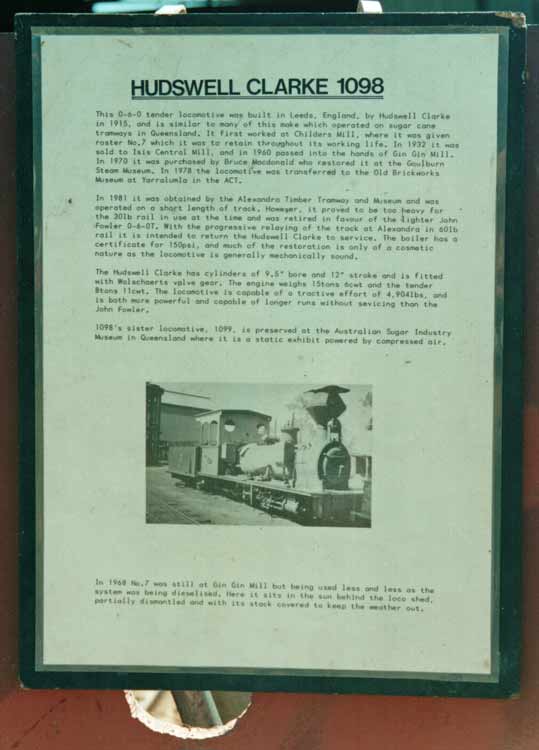
This photo of 1 April 2002 is a bit hard to read but shows
an information sheet attached to 1098's frames.
(At that stage the loco was dismantled
for overhaul in the workshop at Alexandra.)
A transcript is provided below.
|
Builder |
Leeds |
|
Builder’s Number & Year |
1098
of 1915 |
|
Wheel Arrangement |
0-6-0 |
|
The city
of Leeds in West Yorkshire became something of a centre of excellence in the
manufacture of narrow-gauge and industrial steam locomotives, notably due to
builders John
Fowler & Co,
Hunslet
Engine Company Ltd and Hudswell,
Clarke & Co. Ltd. Many Leeds locomotive products graced Australian
rails, from the narrow-gauge units supplied to the sugar cane tramways of
Queensland, through to various timber getting and construction project
machines, standard gauge shunting locos and even a batch of 2-6-0 locos supplied
to the NSW Public Works Department, later becoming the NSW Government
Railways Z(27)
class. Today this manufacturing heritage is celebrated by the Leeds Industrial Museum at Armley Mills, and the website Leeds
Engine Builders provides a fascinating deep dive for ferroequinologists! Among the many
fine Leeds products to come to Australia was this 0-6-0 tender locomotive,
built by Hudswell, Clarke & Co in 1915 to a design that proved very
popular among the sugar tramways of Queensland & Fiji. Like many such
sugar tramway machines, it moved between different owners and locations over
the years, both during its revenue career and in preservation. This
loco’s work started at the Childers Mill where it received running number 7,
an identity it retained through subsequent changes of ownership. It moved to
the Isis Central Mill in 1932 and later to the Gin Gin
Mill, inland from Bundaberg, in 1960. No.7
entered preservation in 1970 when purchased for the Goulburn Museum of
Historic Engines, located at the Marsden Weir pumphouse on the Mulwaree
River, Goulburn NSW, where a significant collection of railway and other
steam equipment was assembled. Here it was returned to operable condition and
saw some service. The
locomotive collection at Goulburn was thinned in the late 1970’s and in 1978,
No.7 moved to the Old Brickworks Museum at Yarralumla, ACT. A further
change of ownership saw No.7 travel south to the Alexandra Timber Tramway
& Museum in Victoria, where it arrived in 1981. Apparently, it was
initially steamed but found to be too heavy for the 30lb rail then in use.
The loco was dismantled for overhaul while the permanent way was upgraded to
60 lb rail, with operations entrusted in the meantime to Fowler No.5. My visit
to Alexandra in April 2002 found No.7 dismantled for overhaul, and I
understand it remains in this condition in 2026. Here is a transcript of the
information sheet shown above, which provides some detailed information: This
0-6-0 Tender locomotive was built in Leeds, England by Hudswell Clarke in
1915, and is similar to many of this make which
operated on sugar cane tramways in Queensland. It first worked at Childers
Mill, where it was given roster No.7 which it was to retain throughout its
working life. In 1932 it was sold to Isis Central Mill, and in 1960 passed
into the hands of Gin Gin Mill. In 1970 it was
purchased by Bruce Macdonald who restored it at the Goulburn Steam Museum. In
1978 the locomotive was transferred to the Old Brickworks Museum at
Yarralumla in the ACT. In
1981 it was obtained by the Alexandra Timber Tramway and Museum and was
operated on a short length of track. However, it proved to be too heavy for the
30lb rail in use at the time and was retired in favour of the lighter John Fowler 0-6-0T. With the
progressive relaying of the track at Alexandra in 60ld rail it is intended to
return the Hudswell Clarke to service. The boiler has a certificate for
150psi, and much of the restoration is only of a cosmetic nature as the
locomotive is generally mechanically sound. The
Hudswell Clarke has cylinders of 9.5" bore and 12" stroke and is fitted
with Walschaerts valve gear. The engine weighs 15 tons 6 cwt and the tender 8
tons 11 cwt. The locomotive is capable of a tractive effort of 4,904lbs, and
is both more powerful and capable of longer runs without servicing than the
John Fowler. 1098's
sister locomotive, 1099, is
preserved at the Australian Sugar Industry Museum in Queensland where it is a
static exhibit powered by compressed air. The Alexandra
Timber Tramway & Museum website contains additional information &
photographs for this locomotive. In addition, an excellent source of
information on the various Hudswell Clarke steam locomotives employed in
Australia and Fiji is ‘Salute to the Hudswells’ by Ian Stocks, David Mewes
and John Browning, as referenced below. |
References
|
a |
Light
Railway Research Society of Australia Inc. web site (retrieved 11 February 2026): 'Preserved Australian Sugar Cane
Locomotives' list by John Browning |
|
b |
Alexandra
Timber Tramway & Museum website Locomotives/ Steam page, retrieved 19 August 2026. |
|
c |
‘Salute to the Hudswells’ by
Ian Stocks, David Mewes & John Browning Published
by Australian Narrow Gauge Railway Museum Society, 2014. |
Page updated: 10 September 2026
|
Government Railways: |
|
|||||||||
|
Private & Industrial Railways: |
|