|
|
No. 1 Powerhouse Museum, Castle Hill |
|
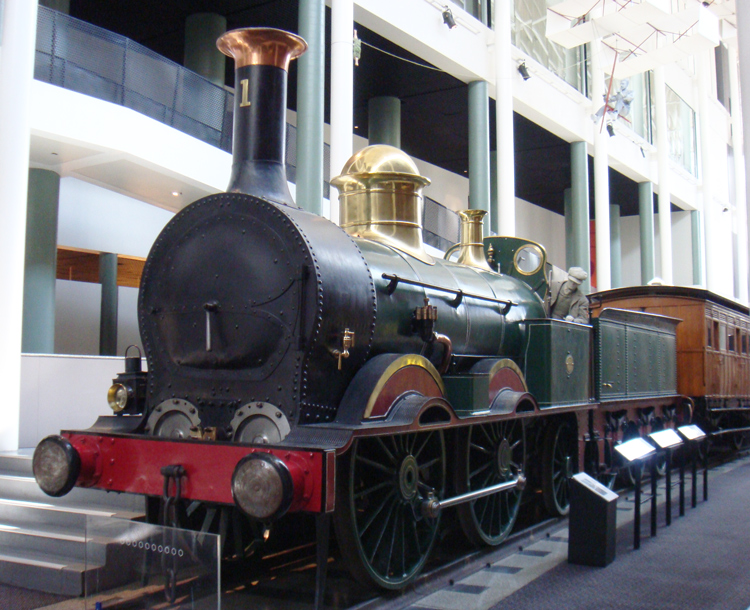
No. 1 and vintage carriages displayed as a key exhibit at
the Powerhouse Museum in Sydney, as seen on 3 May 2009.
The locomotive is exhibited in its 1850s
appearance excluding the simple roof added over the footplate in 1865.
The mannequin crewman stares nervously at
the injectors, frozen in position since the 1980s.
No.1 is displayed on lengths of original Barlow rail.
|
Builder |
Newcastle-on-Tyne, England |
|
Builder’s Number & Year |
958 of 1854 |
|
Wheel Arrangement |
0-4-2 |
|
No. in class |
4 |
|
The first
locomotives for the NSW Railways were four 0-4-2 locomotives supplied by
Robert Stephenson & Co. of Newcastle-on-Tyne, which arrived in Sydney in
January 1855 in preparation for the opening of the Sydney to Parramatta
Railway. These locomotives were designed by James McConnell of London &
North Western Railway (LNWR) fame, based on his 1854 express goods 0-6-0
design. Consequently the 0-4-2 locomotives shared some features with his contemporary
LNWR locomotives including the lined Brunswick green livery and decorative
McConnell dome and safety valve bonnet. Robert Stephenson & Co
construction also reflects No. 1’s pedigree, that firm being central to the
dawn of steam railways, with their very first locomotive ‘Locomotion’ built
for the Stockton & Darlington Railway in 1825. Later Robert Stephenson
& Co. products include the innovative and famous ‘Rocket’ of the Rainhill
Trials for the Liverpool & Manchester Railway in 1829, with its more
efficient boiler and inclined cylinders winning the Rainhill contest and establishing
the design principles for all subsequent steam locomotives. No. 1 was
used on construction trains for the Sydney to Parramatta Railway, including a
special service remembered as the first passenger train which ran from Sydney
Station to Long Cove viaduct on 28 May 1855. The official opening ceremony
was held on 26 September 1855, with formal duties that day performed by
sisters Nos. 2, 3 & 4 as No. 1 required some running maintenance.
Nonetheless, No. 1 is remembered hauling the first train for the NSW
Railways. As the NSW railway system expanded and additional locomotives were
obtained, these four pioneering machines became known as ‘Class 1’. These
‘Class 1’ locomotive have several design features typical of the 1850s. The
0-4-2 wheel arrangement was apparently well suited to both passenger and fast
freight duties at the speeds of the day. The lined green livery, copper-top
chimney, polished ornamental brass steam dome and safety valve covers reflect
the civic pride in the new railway technology, capable of moving passengers
and freight at previously unimaginable speed. They had a powerful appearance
and indeed proved a little too heavy for the original Sydney to Parramatta
per-way, laid with ‘Barlow’
bridge rails, which were subsequently replaced with heavier Bullhead rails. One
typical feature of early locomotives was the lack of an enclosed cab, with
the crew exposed to hot and cold, rain and wind on the open footplate, reflecting
the limited interest placed on crew comfort and occupational safety during
the period. The ‘cab’ effectively consisted of a spectacle plate (with brass
window frames and trimmings) and the cab floor! It is difficult to reconcile
this lack of provision with the status of locomotive drivers in the 1850s;
masters of the new railway technology entrusted with safe operation of their
iron steeds and the travelling public at high speed and heavy loads. It must
have been difficult and dangerous to keep timetabling with safe operation in
the violence of a Sydney summer thunderstorm! A simple cab roof was added in
1865, essentially a curved sheet of corrugated iron supported by four steel
upright poles, but enough to significantly improve conditions for the crew. The Class
1 locomotives continued in use on mixed & suburban trains around Sydney,
apparently successful as four near copies were built in 1871 becoming the
M(36) class. By the mid-1870’s the original locomotives Nos. 1-4 were in need
of heavy repair and replacement frames were delivered by Robert Stephenson
& Co. but a subsequent change of plan saw those frames used to construct
4 new M(36) class locos and the original Nos. 1-4 were withdrawn, with No. 1
recorded as officially withdrawn in June 1877 after 250 468 km travelled.
Upon withdrawal, Nos. 1-4 surrendered their tenders to the four new M(36)
class machines. One of these later locomotives also survives – M 78 at the NSW Rail Museum, Thirlmere – providing an
interesting comparison with No. 1. Initial
Preservation The
tenderless hulks of Nos. 1-4 languished on the ‘Rotten Row’ workshops siding
in Sydney for some years, pending disposal. Fortunately, in 1884 a
far-sighted railway official recognised the historical significance of No. 1
and gave instructions for its preservation. The remaining components required
considerable refurbishment, with various items salvaged from sisters Nos. 2-4
also languishing on the scrap siding. The reconstituted Class 1 locomotive
was transferred into the care of the Museum of Applied Arts & Sciences
(MAAS) at Ultimo in May 1884. The MAAS's
original building was a modest structure in the Domain, where No. 1 was first
displayed. In 1893 No. 1 was transferred to an outbuilding behind the
Museum's new home in Harris Street, Ultimo. From time-to-time No. 1 departed
the MAAS for display in connection with significant civic events: ·
1905 – No. 1 was transferred to railway metals for
celebrations of the NSW Railways 50th Anniversary, with various
official photographs taken on No. 1 and a string of 6 elderly 4-wheel
passenger carriages. At that stage No. 1 was paired with an M(36) class
tender; alas it seems that tender – and presumably most of the passenger stock
- ultimately did not survive. ·
1938 – No. 1 was restored for the national sesquicentenary.
At this stage a surviving Class 1 tender (No. 1’s original tender, TAB 1) was
identified paired with M(36) class loco No. 78 which had been plinthed at
Enfield Locomotive Depot since 1928. This tender was retrieved and restored,
together with No. 1. ·
1955 – No. 1 was displayed in the Central Station
forecourt for the NSW Railways' Centenary celebration, together with a replica
3rd class passenger carriage. Confirmation
of Identity There had
been some conjecture that the preserved No. 1 was in fact No. 2, which had
remained in use as a Sydney yard shunter until December 1879, reconstituted
with No. 1’s identity. This question was resolved during extensive
conservation and restoration work performed in the late 1970s by the Museum
of Applied Arts & Sciences. Stamps on the various components were
uncovered and inspected during this conservation work, revealing that the
preserved locomotive No. 1 predominantly comprised the main components of
loco No. 1, together with some components from sisters Nos. 2, 3 & 4. (This
mix of components possibly reflects both normal workshop attention during its
service life, and the 1884 reconstitution and refurbishment.) My first
encounter with No. 1 was during a visit to the MAAS Ultimo circa 1980. I
recall the locomotive was crammed into a small annex at the rear of the
museum, and access required us to be accompanied by a staff member for a
brief inspection. It was very difficult to appreciate the locomotive in its
cramped location. Powerhouse
Museum, Ultimo Recognising
that the MAAS had outgrown its original premises at Ultimo and in order to
provide greatly expanded exhibition space for No. 1 and many other exhibits both
large and small, the redundant tramways power station nearby was repurposed and
redeveloped as ‘The Powerhouse Museum’, while the adjacent tram barn became
the administration offices and conservation workshop. In 1987, No. 1 was
placed on display as a prime exhibit in the Powerhouse Museum, together with
three period passenger carriages, displayed on lengths of original Barlow
rail. The
Powerhouse Museum at Ultimo formally opened during the Bicentennial year of 1988
with celebrated architecture combining the old power station with modern
additions, winning the Sir John Sulman Medal for architecture. Decades later,
the Powerhouse site at Ultimo was attracting the attention of a later
generation of politicians, with a proposal to sell off the site for
redevelopment and move the entire museum to a new site in Parramatta. Some
minor features at the Ultimo museum were showing their age; for example, the
bathrooms still featured 1980s checkerboard tiling and were described by some
as a museum piece in their own right! Fortunately, public outcry scuppered
the plan to sell off the Ultimo museum site but the award-winning 1980s additions
were demolished as part of a refurbishment, while a new museum also began construction
at Parramatta. To
facilitate renovation of the Powerhouse Museum at Ultimo, No. 1 and its train
were road hauled to the Powerhouse Castle Hill on 18 July 2024. I understand
they can be inspected there on weekends and are to be returned to Ultimo when
the Powerhouse Ultimo refurbishment is complete. On 7 November
2026, the Powerhouse Museum opened its impressive new buildings at
Parramatta. (This site was controversial, having been built on flood prone land
alongside the Parramatta River and requiring the demolition of
heritage-listed buildings including an Italianate mansion ‘Willow Grove’ and a
row of seven terrace houses ‘St George’s Terrace’.) Today
Locomotive No. 1 is a jewel in the Powerhouse Museum collection, being significant
at a world level as a very rare example of locomotive design and construction
from the period. The Powerhouse Museum website includes this comprehensive exhibit
description for Locomotive No. 1 McConnell’s
L&NWR ‘Bloomer’ locomotives: An
interesting comparison to NSW Railways No. 1 can be found in the replica LNWR
‘Bloomer’
express passenger 2-2-2 locomotive No. 670 under construction at Tyseley
Locomotive Works in the UK. This project seeks to recreate one of McConnell’s
more significant NNWR designs, presented in its original pre-1862 condition.
Started in the 1980s, the replica Bloomer is approximately 90% complete but
the project is currently languishing with some components outstanding,
including the chimney and cab spectacle plate. While such a locomotive would
have only limited operational utility today, it would be a highly significant
running exhibit. An
accurate Bloomer replica (numbered 1009) has also been placed as a static
exhibit at Milton Keynes Museum, representing the class in mid-1870s
condition. Similarities
between the LNWR Bloomer locomotives and NSW Railways No. 1 can be seen not
only in the general design and proportions, but also specific details such as
the McConnell steam dome cover and safety valve bonnet. The early NSW
Railways also operated several 2-2-2 express passenger locomotives, most
famously the elegant, high-stepping T(14) class of 1865 remembered for ‘The
Fish’ express to Penrith, but that wheel configuration has long since been
consigned to history in Australia. |
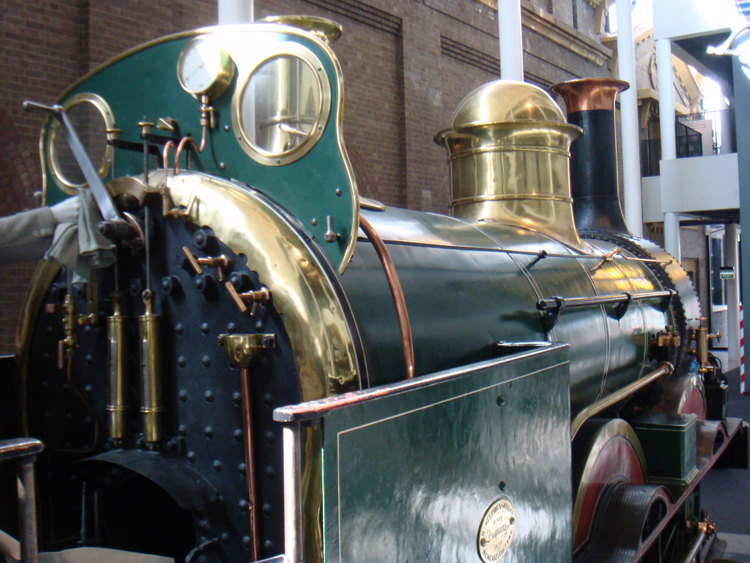
A forward view highlights the ornate spectacle plate and
dome, together with the spartan cab.
The builder’s plate can be seen affixed to the cabside. Photo
date: 3 May 2009
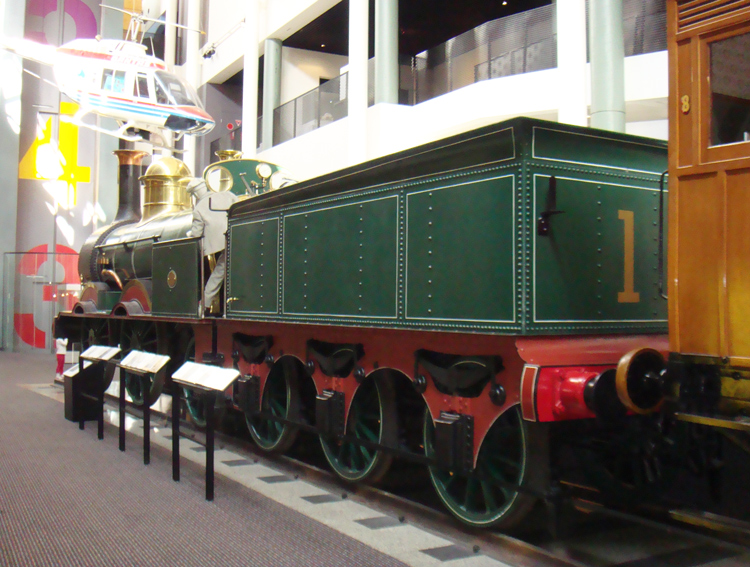
This view emphasises the tender, No. 1’s original ‘Tab 1’. Photo
date: 3 May 2009
Loco No. 1 is seemingly in danger of crashing into a
helicopter; the juxtaposition of technologies and eras is intentional but
rather awkward.
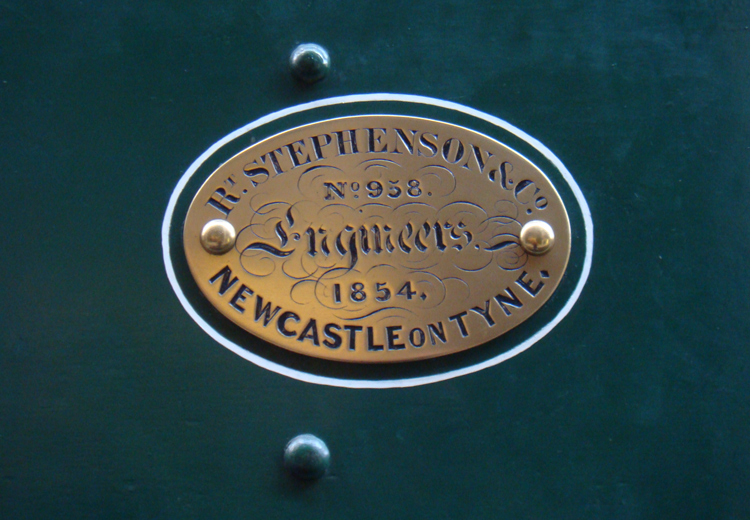
No. 1’s builder’s plate attests to its Robert Stephenson
& Co. pedigree. 3 May 2009
References
|
a |
‘A Compendium of New South Wales Steam Locomotives’ compiled by Alex Grunbach, published by the Australian Railway
Historical Society, New South Wales Division, 1989. |
|
b |
‘Steam
Locomotive Data’ July 1974 edition, compiled by J. H. Forsyth for the Public
Transport Commission of NSW. |
|
c |
Wikipedia – LNWR Bloomer class https://en.wikipedia.org/wiki/LNWR_Bloomer_Class |
|
d |
Powerhouse Museum website https://collection.powerhouse.com.au/object/19352 |
|
e |
Eardley, G. H. 'Locomotives
Beyond Recall', published by the NSWRTM, 1976. |
|
f |
LNWR Bloomer Class -
Wikipedia - https://en.wikipedia.org/wiki/LNWR_Bloomer_Class |
|
g |
Powerhouse Museum -
Wikipedia - https://en.wikipedia.org/wiki/Powerhouse_Museum |
Page updated: 12 November 2026
|
Government Railways: |
|
|||||||||
|
Private & Industrial Railways: |
|