|
|
M 78 NSW Rail Museum, Thirlmere |
|

No. 78 displayed at the NSW Rail Transport Museum on 23
November 2008.
This magnificent antique locomotive has been beautifully
restored by NSW Rail Museum volunteers.
|
Builder |
NSW Railways |
|
Builder’s Number & Year |
Built 1877 |
|
Wheel Arrangement |
0-4-2 |
|
No. in class |
8 |
|
Built in
1877, this fascinating locomotive owes its design to earlier machines,
including the first steam locomotives to operate in New South Wales. These
pioneering engines were the ‘Class 1’ locomotives, represented today by the
famous No. 1 in the Powerhouse Museum
collection. Steam
traction on the NSW Railways began with four ‘Class 1’ 0-4-2 locomotives
built by Robert Stephenson & Co. in 1854. The 0-4-2 wheel arrangement was
repeated in subsequent early NSW locomotives, including three similar ‘Class
1N’ engines delivered in 1856 for the then-isolated Northern (N) railway at
Newcastle, together with two smaller contractor's locomotives, No. 5 and No.
4N. These were joined in 1871 by four members of the M(36) class for Sydney
suburban service, essentially copies of the original Class 1 locomotives Nos.
1-4. The 0-4-2 wheel arrangement proved well suited to the suburban and
mixed-traffic duties of the period, which typically involved relatively light
loads of four-wheel rolling stock. Locomotive
design evolved over time, with 4-4-0 locomotives becoming the preferred
choice for passenger services, their leading bogies improving stability and
tracking at higher speeds. Meanwhile, 0-6-0 locomotives became dominant on
freight duties, as their entire weight contributed to adhesion and therefore
tractive effort. Against this background, the 0-4-2 wheel arrangement was
becoming somewhat outdated by 1877, although it continued to provide useful
service. In 1874,
the NSW Railways received replacement frames from Robert Stephenson & Co.
with the intention of rebuilding the original Class 1 locomotives Nos. 1-4
and extending their working lives. By this time, the four members of the more
modern M(36) class 0-4-2 locomotives (Nos. 36-39) had already been in service
since 1871. An administrative decision ultimately led to the replacement
frames being used to construct four new M(36) class locomotives rather than
rebuild the ageing Class 1 engines. The four new locomotives became Nos.
75-78, while locomotives 1-4 were retired and their tenders reallocated to
the new M(36) class engines. The eight
members of the M(36) class were employed on Sydney suburban passenger
services, much as the Class 1 locomotives had been since the opening of the
original Sydney-Parramatta railway. In time, they were displaced by newer and
more numerous locomotive classes. M 78 became obsolete and was sold to a
contractor in 1896 for railway construction work. It later worked for the
Public Works Department on projects including construction of the Dorrigo
branch line. Under the
1924 renumbering system, the sole surviving M(36) class locomotive, No. 78,
received the road number 1004 in the X10 grouping of obsolete and
miscellaneous locomotives, a category that also included crane locomotives
and similar equipment. Preservation
at Enfield No. 78
began its preservation career when it was plinthed at Enfield Locomotive
Depot, Sydney, in 1928. At that stage it was still paired with its original
Class 1 tender, notable for its outside springing. Around 1938, the Museum of
Applied Arts and Sciences (MAAS) requested this tender for the restoration of
locomotive No. 1. As a result, a replacement tender was provided for No. 78
in the form of a B(55)/Z(24) class tender from one of those 2-6-0
locomotives, such as 2419, dating from
1892. As an
aside, No. 1 appears to have been paired with an 1871-vintage M(36) class
tender following its initial preservation in 1884. However, that tender was
not returned to Enfield for use behind No. 78 and was presumably scrapped at
the time. No. 78
remained plinthed in a prominent position outside the Enfield office,
overlooking a roundhouse arrival road. For many decades it witnessed the
passing procession of increasingly modern and powerful locomotives, each new
generation further emphasising the growing antiquity of the little 0-4-2. As the
steam era drew to a close, the newly established NSW Rail Transport Museum
(NSWRTM) began assembling a collection of significant railway exhibits in
Enfield No. 1 Roundhouse. By 1973, No. 78 had been moved into the roundhouse
for display alongside other museum exhibits. After forty-five years of
exposure to the elements, the locomotive had become significantly weathered. Transfer
to Thirlmere The
Enfield steam locomotive depot was demolished in 1975, ostensibly to make way
for a container terminal, although such a development did not materialise
until decades later. No. 78 and its tender were loaded onto rail wagons for
transfer to the museum's new site at Thirlmere, south of Sydney. The Z(24)
class tender was reportedly so badly corroded that it was considered beyond
repair upon arrival and was immediately dispatched for scrapping. No. 78 was
then placed on display on an isolated section of track in the museum
courtyard, with 1709's original tender
(TAB 381) substituted in its place. Restoration
and replacement tender Recognising
the locomotive's historic significance, the museum selected No. 78 for a
comprehensive static restoration in the early 1980s. The locomotive was moved
undercover into the exhibition shed, where restoration work commenced. This
not only protected the historic fabric of the locomotive but also greatly
improved its appearance. The search
for a suitable tender led to the discovery of an old tender frame dating from
the 1856, then being used as a sand wagon on the private South Maitland
Railway. This frame had originally belonged to one of the three Class 1N
locomotives mentioned earlier, although its tank and centre axle had been
removed during its long working life. Around
1986-87, the tender was reconstructed as a six-wheel tender by the Hunter
Valley Training Company, with the work funded through a grant scheme. A new
riveted water tank was fitted and a dummy centre wheelset installed. The
centre axle is in fact a hollow steel pipe and therefore unsuitable for
operation; the tender is intended solely for static display. Today,
this tender is possibly the oldest exhibit in the NSW Rail Museum collection. The
restoration of No. 78 was a remarkable achievement by NSWRTM volunteers and
demonstrates what can be accomplished when sufficient resources and expertise
are available. Today, the locomotive is displayed prominently at the entrance
to the NSW Rail Museum's exhibition hall, where it provides an important link
to the earliest days of railways in New South Wales. Not only does its
overall design trace its ancestry directly to the colony's first locomotives,
but its tender also has origins dating back to the earliest era of railway
operation in the state. A comparison with the Powerhouse Museum's locomotive No. 1 reveals many of these family similarities. Overseas
parallels Another
interesting 0-4-2 locomotive in preservation is London, Brighton & South
Coast Railway ‘B1 Class’ locomotive ‘Gladstone’
in the National Railway Museum collection, based at York. It seems the
LB&SCR persisted with the 0-4-2 design in heavy passenger work long after
4-4-0 designs has become prevalent around the world. |
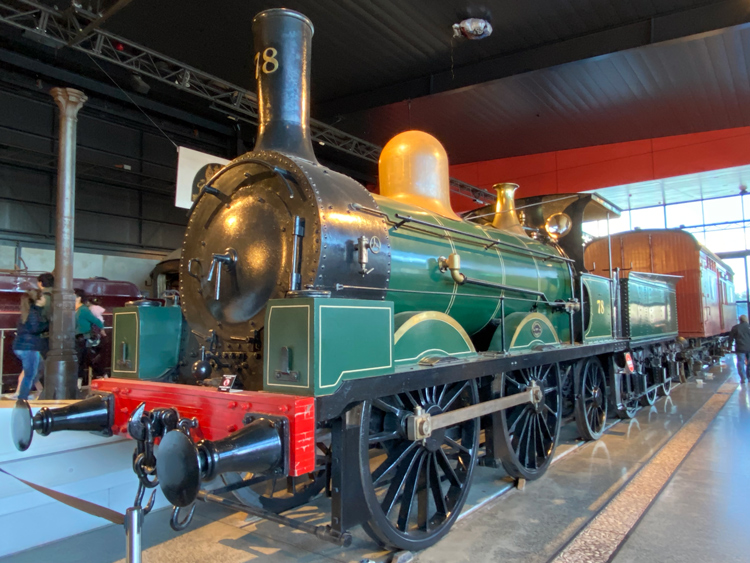
No. 78 is now prominently positioned in the display hall at
the entrance to the NSW Rail Museum, as seen above on 25 June 2022.
This shot was snapped on a very busy day,
during a momentary gap between passers-by!
The restored wooden front buffer appears to be a composite
of horizontal members, alas slowly delaminating.
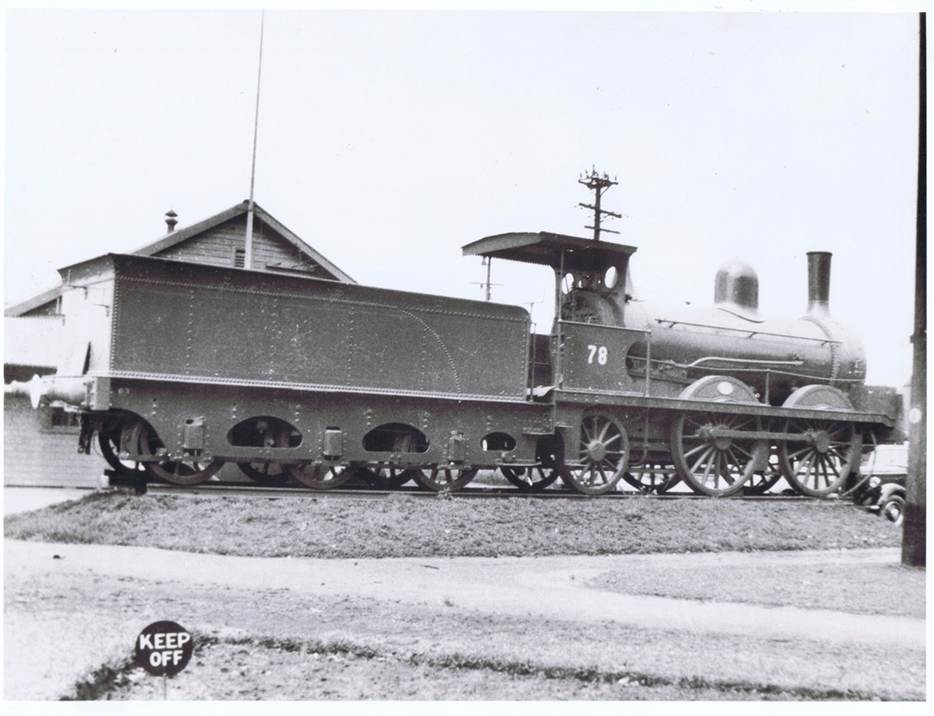
An undated view of M 78 plinthed at Enfield locomotive depot,
once the site of three roundhouses and home to a fleet of standard goods
engines.
It is paired with a B 55 / Z (24) class
tender, its previous tender having gone to the MAAS for display with Loco No.1.
This photo was contributed by Bruce Saunders.

|
This H(373) / Z(17)
class tender accompanied M 78 when plinthed at the Thirlmere museum forecourt
in the mid-1970’s. This
tender was originally fitted to 1709, with its identity ‘Tab 381’ referencing
the original H(373) class running number. Tender
Tab 381 remains stored at the NSW Rail Museum pending eventual restoration
for pairing with 1709. In
this view it is seen stored alongside the Thirlmere ‘Loop Line’ on 23
November 2008. (There was once a long passing
siding at this location, hence the extra width in the trackbed despite being
in a shallow cutting.) |
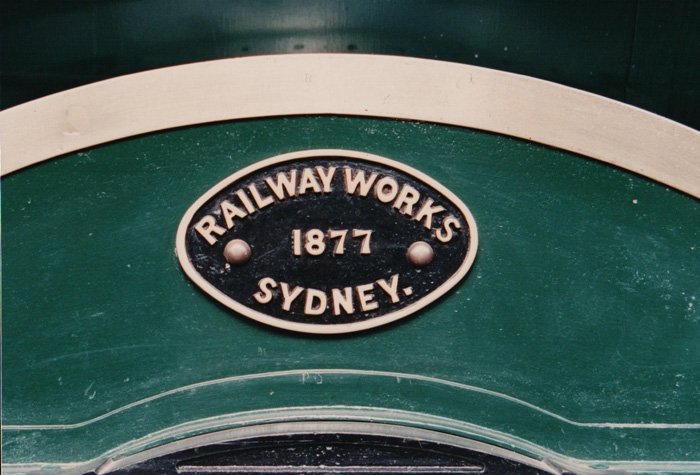
The builder's plate on No. 78's splasher attests to the
locomotive’s antiquity.
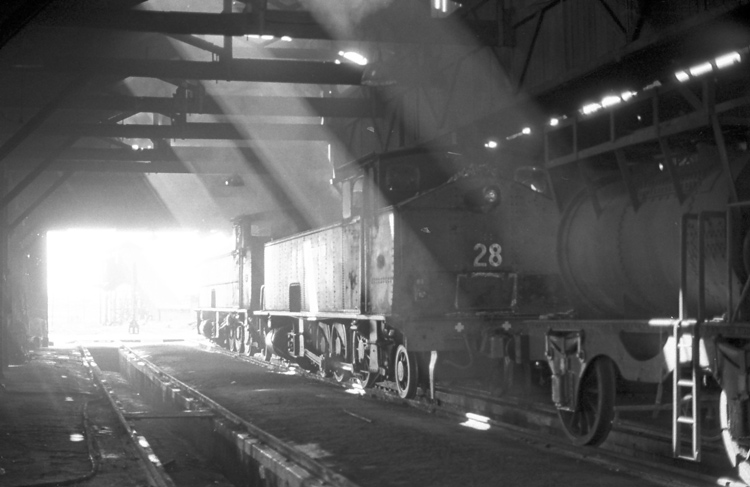
This atmospheric slide view was kindly provided by Anthony
Winstone and shows SMR 22 and 28 within the SMR East Greta loco depot in 1980.
The unusual sand wagon behind the locos
is built on the tender frame of a very early NSWGR 1N class steam loco;
this tender frame was subsequently used in
the recreation of an appropriate tender for M 78 during the 1980's.
As can be seen, this ancient 6-wheel tender was missing its
centre wheelset at that lowly stage.
References
|
a |
Eardley, G. H. 'Locomotives: A Guide - Enfield
Railway Museum', published by the NSWRTM, 1973. |
|
b |
‘A Compendium
of New South Wales Steam Locomotives’ compiled
by Alex Grunbach, published
by the Australian Railway Historical Society, New South
Wales Division, 1989. |
|
c |
‘Steam
Locomotive Data’ July 1974 edition, compiled
by J. H. Forsyth for the Public
Transport Commission of NSW. |
|
d |
Eardley, G. H. 'Locomotives
Beyond Recall', published by the NSWRTM,
1976. |
|
e |
Information
provided by Bruce Saunders via emails dated 17 September and 26 September 2026. |
Page updated: 5 November 2026
|
Government Railways: |
|
|||||||||
|
Private & Industrial Railways: |
|