|
|
Kiama Fowler / Public Works Department No.35 / Wollondilly Mandalong Valley Tramway |
|
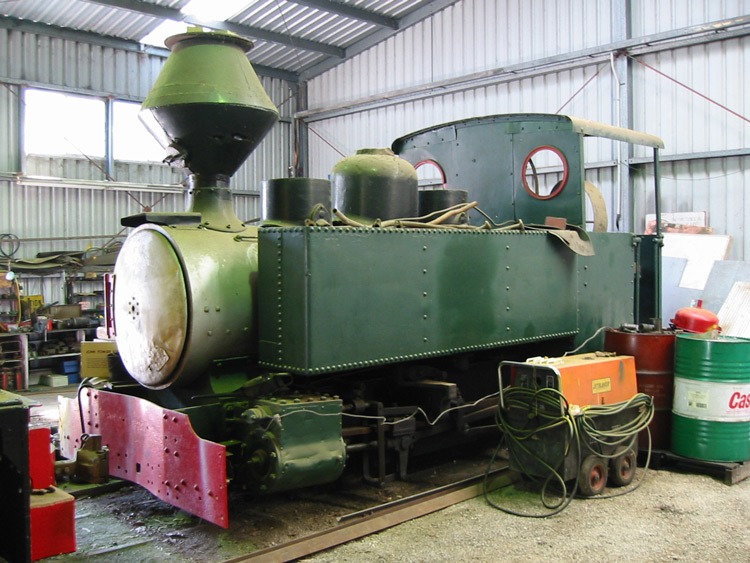
PWD 35 / The Kiama Fowler is seen in storage at
the Illawarra Light Railway & Museum on 19 March 2006.
|
Builder |
John
Fowler & Co, Leeds |
|
Builder’s Number & Year |
16089
of 1923 |
|
Wheel Arrangement |
0-4-0T |
|
This
locomotive was originally Public Works Department (PWD) No.35 (the second PWD
locomotive to carry this number), having been purchased for use on the State
Metal Quarries at Kiama. It is also known as ‘The Kiama Fowler’. PWD 35
entered preservation as early as 1958 when it moved to the Marsden Museum of
Historic Engines at Goulburn. Here it was initially used as a stationary
boiler for the magnificent Appleby Beam Engine which pumped fresh water to
the City of Goulburn and is the centrepiece of the Marsden Museum. PWD 35
later joined the growing collection of 2’ gauge steam locomotives operating
on the 2’ gauge tourist line which was once a feature of the Marsden Museum,
although it didn’t see much use because it was apparently a bit too heavy for
the rails there. Here it gained the name ‘Wollondilly’ in reference to the
river and weir alongside the pumping station, from which the pumping station
drew water. In 1974
the locomotive was purchased for private preservation and dispatched to a
Sydney location. Around
1985 there was a proposal to rebuild a portion of the Kiama quarry railway as
a tourist attraction, with the Kiama Fowler central to the proposal. The
locomotive was displayed at Kiama for a period during 1986 & 1987 prior
to being placed in storage at the Illawarra Light Railway & Museum
Society (ILRMS), Albion Park. Alas the proposal for a tourist railway at
Kiama did not achieve Council approval and the Kiama Fowler remained stored
for many years in the loco shed at Albion Park. It was donated to the ILRMS
in 1998. My visit
to the ILRMS Albion Park on 3 May 2015 found restoration and repair work on
the Kiama Fowler underway, with a return to service anticipated in a few
years. Among the work to be undertaken was replacement of the heavily pitted
smokebox door (as can be seen in the photos below). A large
and diverse range of steam locomotives once served the various industrial
operations situated in the Illawarra; each being documented in Ken McCarthy’s
book 'Gazetteer of Industrial Steam
Locomotives, Illawarra District NSW', which makes for interesting reading for
ferroequinologists. Update
January 2026: A post of
3 July 2022 by Leon Oberg in the Light Railways social media pages provided
news that the Kiama Fowler had recently been sold to Timbertown, Wauchope.
Indeed, my visit there on 11 January 2026 found the loco just visible in the
workshops shed, with a builder’s plate displayed in the Timbertown entrance. Leon’s
Light Railways post makes interesting reading and includes a photo of
‘Wollondilly’ in operation at Goulburn on 6 February 1972: https://www.facebook.com/groups/LightRailwaysAustralia/permalink/5368704106519962/ I had
imagined this historic loco was an appropriate exhibit for the ILRMS and so
I’m surprised it was sold. Alas, Timbertown ceased operations on 28 January
2026 and an auction of assets is expected in May 2026. I understand there is
interest in the railway equipment from overseas bidders; it would be a pity
if this interesting loco was exported. (I’ve included more information and
photographs for Timbertown on the page for ‘Green Hornet’.) Update May
2026: Following
the Timbertown auction in early May 2026, Fowler B/N 16089 ‘Wollondilly’ has
now joined the private collection at the Mandalong Valley Tramway, where its
arrival is expected shortly. |
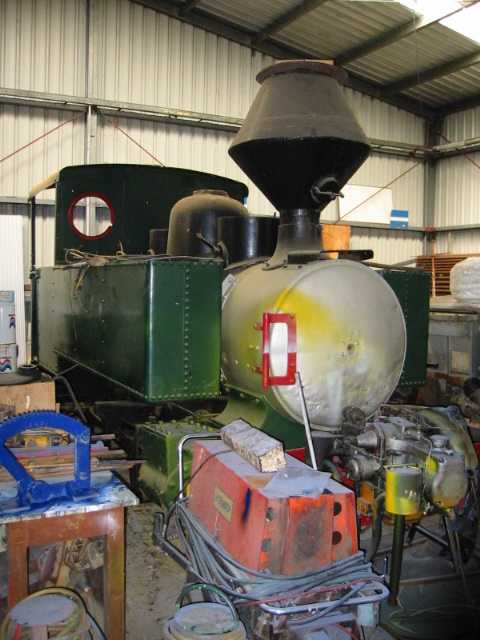
An earlier photo of the Kiama Fowler in storage at Albion
Park. 13 October 2002
The lower portion of the smokebox door shows heavy pitting and distortion and will be replaced.
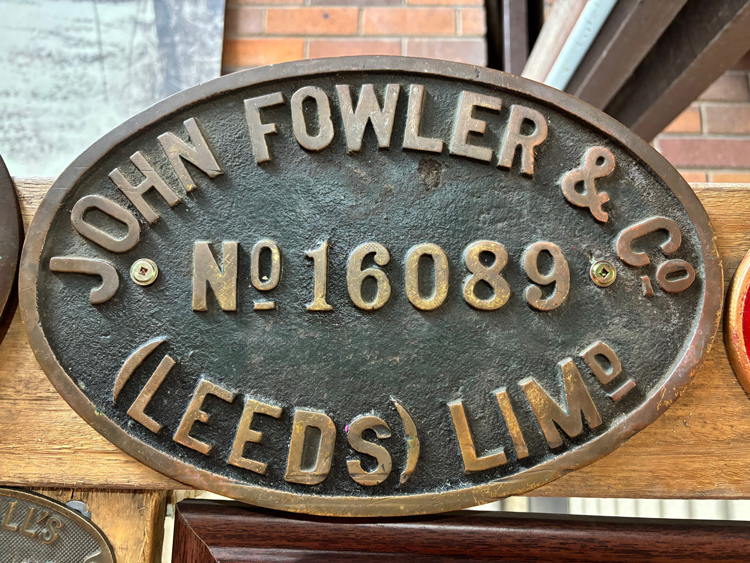
A builder’s plate for PWD 35 was spotted among the exhibits
displayed in the Timbertown entrance. 11 January 2026.
References
|
a |
K.
McCarthy, ‘Guide
to the Main Exhibits - Illawarra Light Railway Museum Society’, published
1992. |
|
b |
McCarthy, K. 'Gazetteer of Industrial Steam
Locomotives, Illawarra District NSW', prepared by Ken McCarthy for the Illawarra Environmental
Heritage Committee. Published by the Australian
Railway Historical Society (NSW Division), December 1983. |
|
c |
Facebook
post in ‘Light Railways of Australia’ by
Leon Oberg, 3 July 2022. |
Page updated: 12 May 2026
|
Government Railways: |
|
|||||||||
|
Private & Industrial Railways: |
|