|
|
S 549 ‘Greenmount’ The Railway Museum, Bassendean |
|
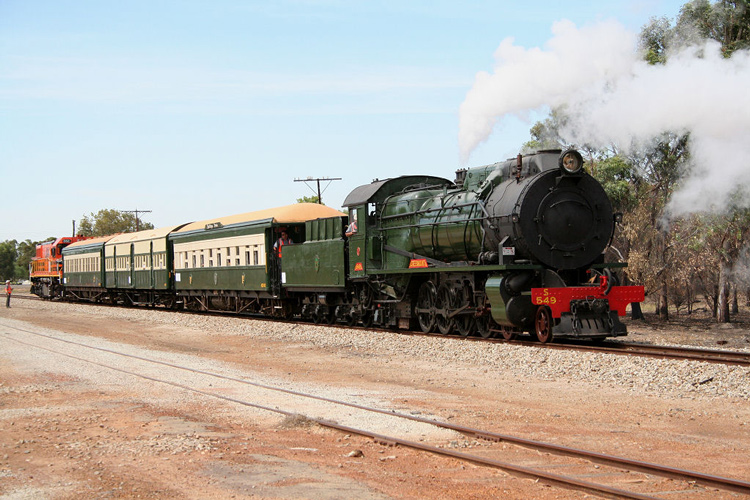
S 549 ‘Greenmount’ on railtour duty at Dowerin on 10
December 2006.
The boiler cowling had again been
truncated by this stage.
This photo was kindly contributed by Phil Melling.
|
Builder |
WAGR Midland Workshops |
|
Builder Year |
1947 |
|
Wheel Arrangement |
4-8-2 |
|
The S-class were the first locomotive type to be entirely designed
and built by the Western Australian Government Railways (WAGR), with the
design team led by Chief Mechanical Engineer Frederick Mills. Although conceived
in the late 1930’s, construction of these powerful 4-8-2 locos was delayed by
competing wartime priorities and material shortages, with the first three
units emerging from the WAGR Midland Workshops in 1943. The class ultimately
grew to 10 units, with 2 more completed in 1945 and another 5 in 1947. The
firebox and boiler design was optimised for the slow-burning local Collie
coal, resulting in a wide diameter boiler and large grate, contributing to
the purposeful look of these imposing machines. It is interesting to note that the competing construction
priorities at Midland Workshops included ten 4-8-2+2-8-4 ASG Garratts, which
were designed by the Commonwealth Land Transport Board under the leadership of
F. Mills. There is a resemblance between the S-class and the contemporary ASG
locomotives, including a skyline boiler cowling running from smokebox to cab –
a streamlining and fashion design feature which is hard to reconcile with
wartime austerity and cost constraints. Given their 4-8-2 ‘Mountain’ wheel arrangement, the
S-class appropriately received names of Western Australian mountains, carried
on brass nameplates attached to the running boards. The class were intended
for mixed traffic duties, although most of their career was spent on freight
turns. Preserved example S 542 was the second completed and named ‘Bakewell’,
being originally numbered 477 among the first three S-class locos in the WAGR
numerical sequence 476 – 478 prior to the full class of 10 being reallocated
into the number band 541 – 550. The S-class locomotives suffered some teething troubles,
leading to early modifications to the steam inlet, regulator and superheater arrangements.
The original domeless boiler design, which incorporated an internal
perforated-pipe steam collector, was replaced by a stubby steam dome and
external steam pipe running to the smokebox via an anti-vacuum valve. One of
the more visible consequences of these modifications was the shortening of
the boiler-top cowling from full length to only half of the boiler length, with
these live steam components remaining hidden under the boiler-top cowling at
the smokebox end while other items – notably the safety valves – were now
revealed further along the boiler top towards the cab. Other early modifications include the replacement of
exhaust steam injectors with live steam injectors, and the addition of
flanges to the leading driving wheels. These modifications were also made to
the ASG Garratts, again suggesting the latter’s relationship to the S-class design. Five of the original low-sided tenders were rebuilt in the
1950’s to a high-sided design, which increased water capacity at the expense
of coal capacity. S 549 retained one of the original low-sided tenders. Adrian Gunzberg provides a full history of the S-class and
the various design modification in his authorative book ‘A History of WAGR
Steam Locomotives’. This book includes a fine colour photo of sister S 542 in
steam on the front cover! Nine members of the class were officially withdrawn in
June 1971, with S 549 ‘Greenmount’ the exception and lasting until August
1972. Fortunately,
it was saved to represent the type by the Australian Railway Historical
Society (WA Division) in December 1972 and placed on display at The Railway Museum,
Bassendean. In 1985 a 10-year restoration program began, culminating in the 1995 relaunch of S 549 as an operational exhibit. An interesting feature of its restoration was the reinstatement of the boiler-top cowling to its original full length back to the cab. After some main line tours and steam-up events, S 549 was withdrawn from operation in 2025 and now requires overhaul. My visit
to Bassendean of May 2002 found S 549 displayed in wartime black livery. Later
photos show S 549 was subsequently repainted to WAGR green livery. Rowan
Kinnane / Rail Media Productions has recorded this interesting video of S 549: https://youtu.be/fGFQ5FlUBLU?si=Qcu-czHSbVwK5e1Z I’ve also included below a series
of detailed photos of S 549 by Rowan Kinnane; these views are dated 27 August
2025. Two other
S-class locomotives survive. While the WAGR scrapped most of its modern steam
fleet in the early 1970’s, apparently a small reserve – perhaps 20 locos from
the Pm/Pmr/S/V and W classes - was retained through the 1970’s and many were
subsequently rescued for preservation, as listed elsewhere on this site.
Among these were S 542 ‘Bakewell’
plinthed at East Perth Terminus Station in 1976, and S 547 ‘Lindsay’ purchased by the Bellarine Railway in
1980. The last steam locos scrapped by the WAGR were 2 W-class and 2 V-class
around 1980; I’m hoping one day to obtain full details of this apparent WAGR
steam reserve and the various disposal dates. |
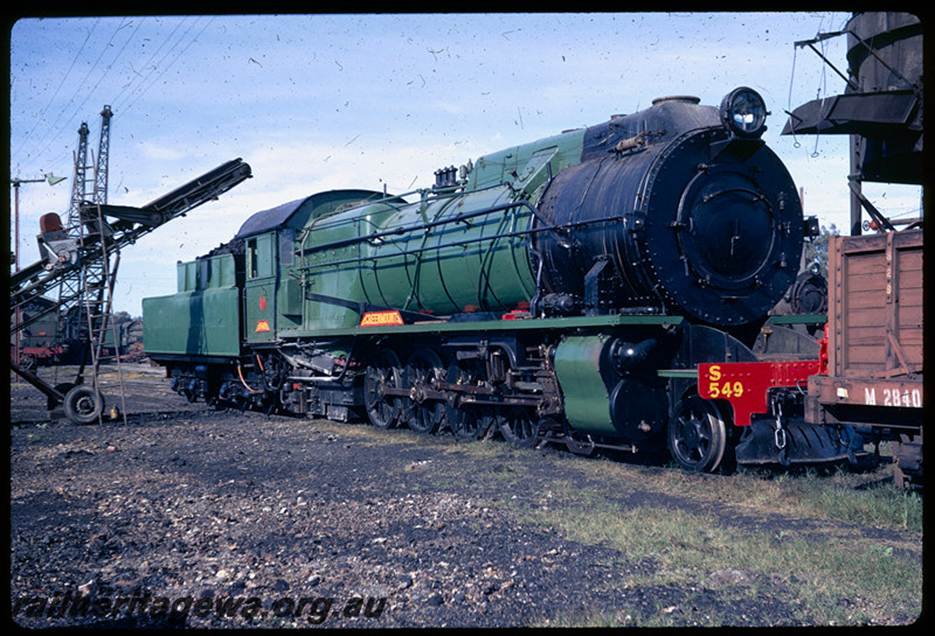
S 549 ‘Greenmount’, recently overhauled, Midland loco
depot, coal conveyor, coaling tower, M Class 2840 coal box wagon.
Photo dated 31 August 1970.
Image used with permission of the Rail
Heritage WA archive:
http://railheritagewa.org.au/archive_scans/displayimage.php?pid=28787
(Image reference T06306, original photographer – N.
Pusenjak)
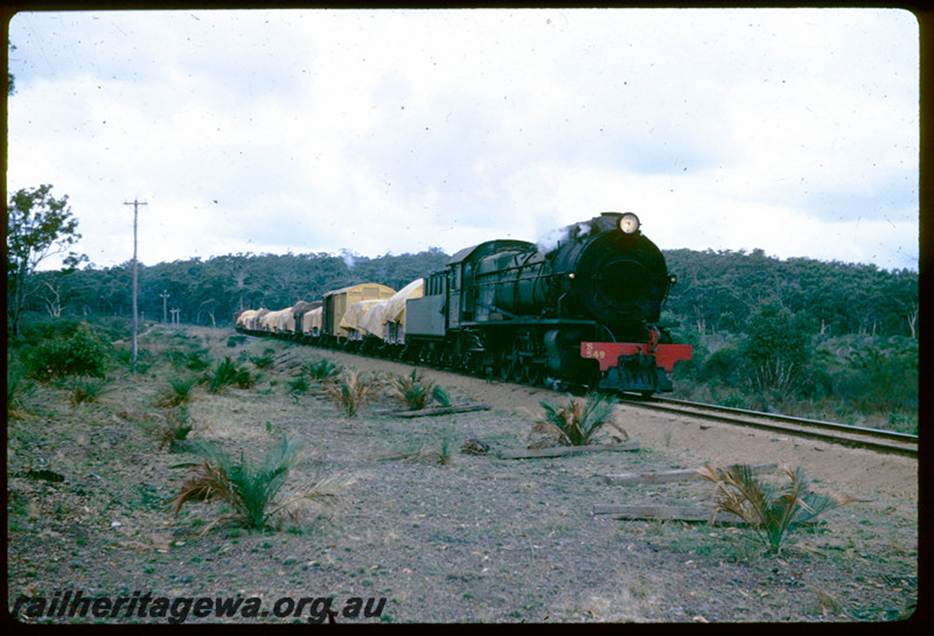
S 549 ‘Greenmount’ heads a good near Collie. Photo dated April
1971.
Image used with permission of the Rail
Heritage WA archive:
http://railheritagewa.org.au/archive_scans/displayimage.php?pid=28968
(Image reference T06487, original photographer – N.
Pusenjak)
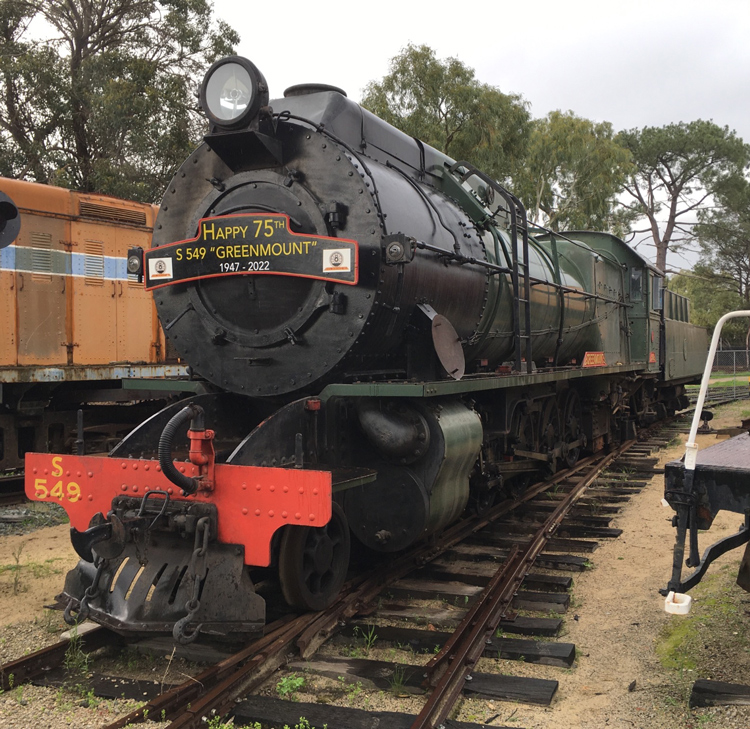
S 549 rests at Bassendean on a drizzly winter’s day.
Photo kindly contributed by Rowan Kinnane and dated 27
August 2025.
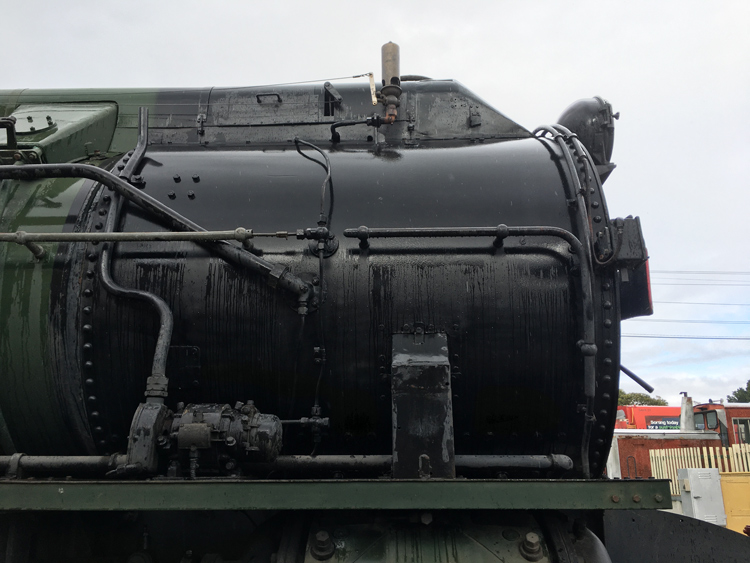
Smokebox detail, including generator mounted on the footboard,
whistle & pull-cord.
Photo kindly contributed by Rowan Kinnane and dated 27
August 2025.
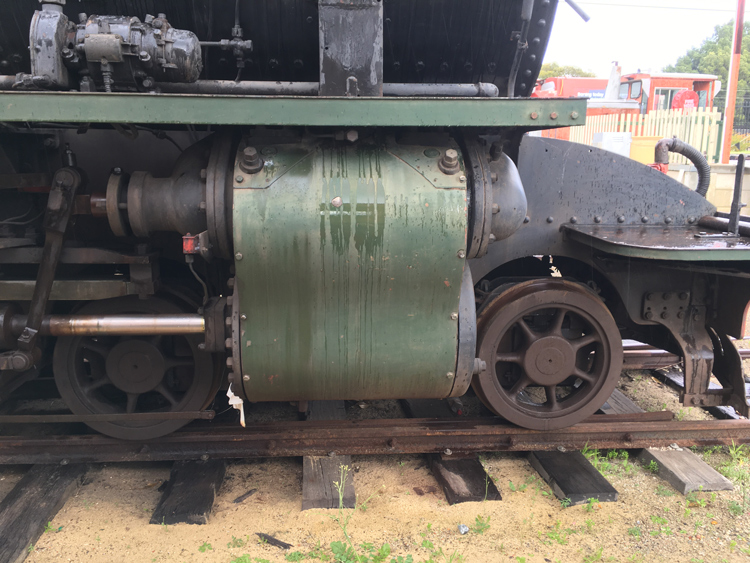
Cylinder detail.
Photo kindly contributed by Rowan Kinnane and dated 27
August 2025.
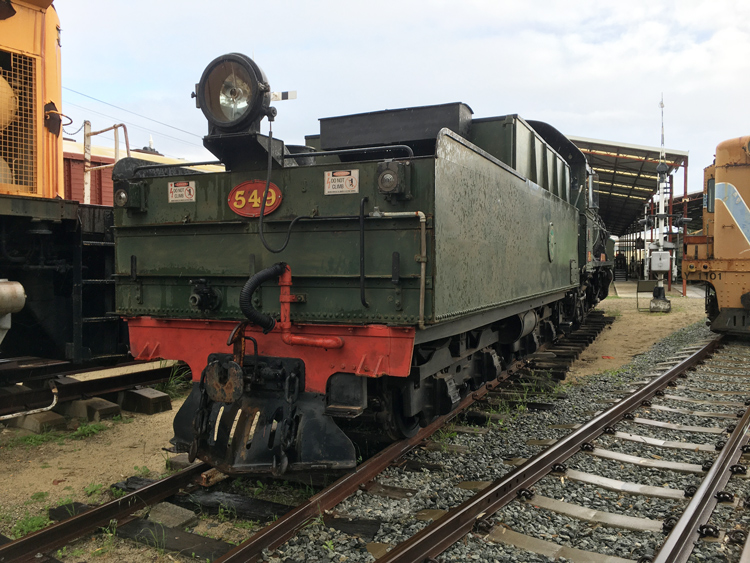
Rear tender view.
Photo kindly contributed by Rowan Kinnane and dated 27
August 2025.
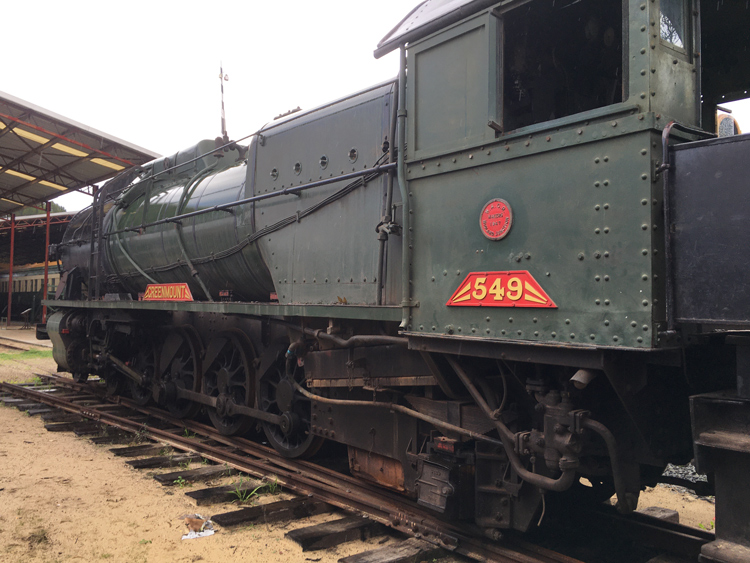
S 549’s builder’s and number plates are prominent on the
cabside, while the stylish nameplate is mounted above the running boards.
Photo kindly contributed by Rowan Kinnane and dated 27
August 2025.
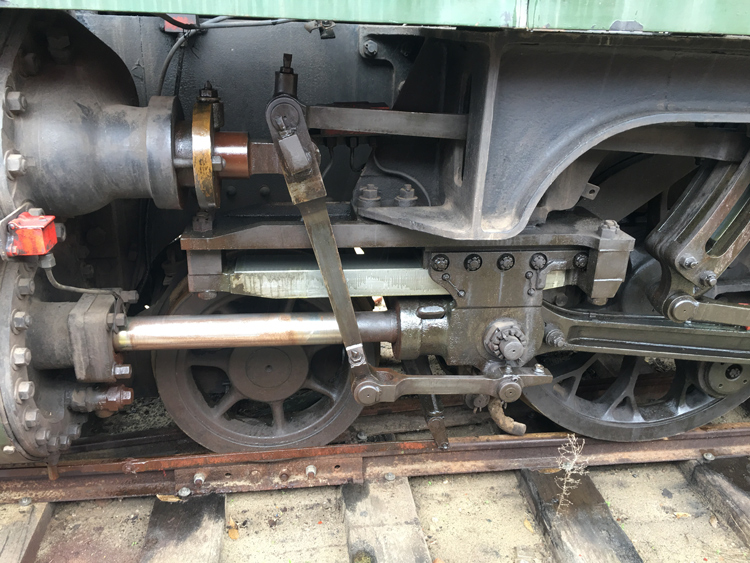
Crosshead, slide-bar and valve gear detail.
Photo kindly contributed by Rowan Kinnane and dated 27
August 2025.
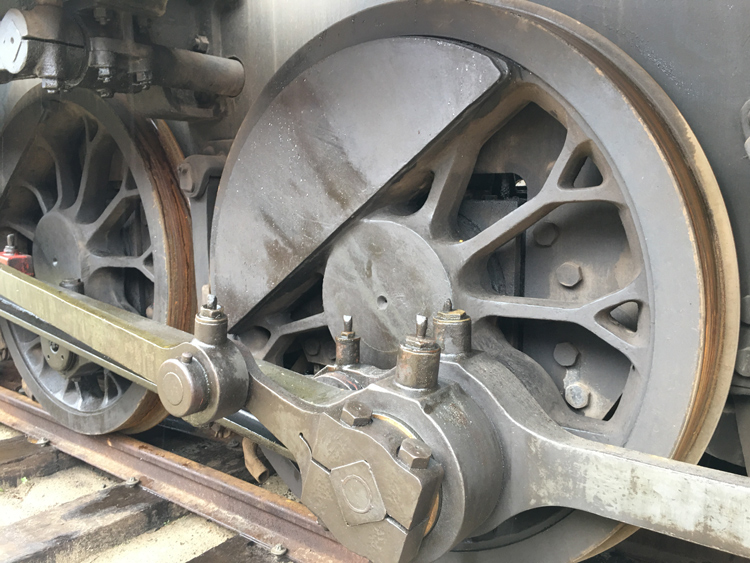
Big end & return crank detail, with inbuilt oil pots
protruding above the bearings. A sanding pipe appears just ahead of the drive
wheel.
Photo kindly contributed by Rowan Kinnane and dated 27
August 2025.
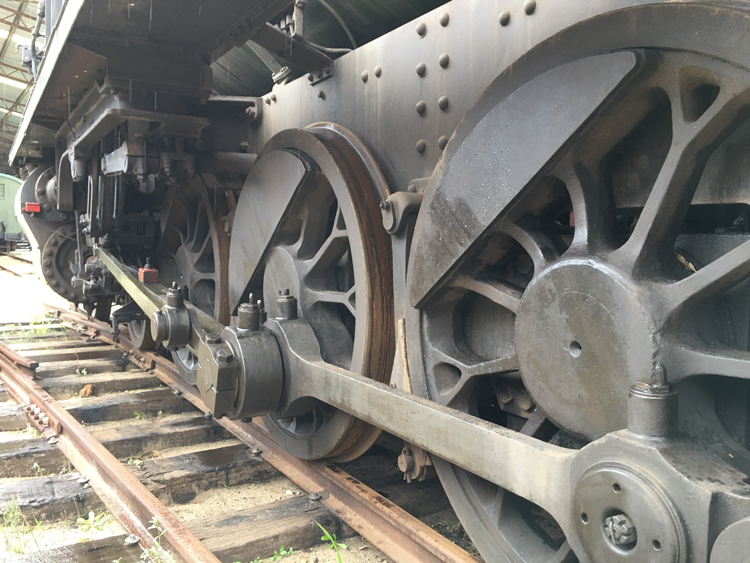
A nice view of the wheels & motion including connecting
rods, bifurcated wheel spokes and counterweights.
Photo kindly contributed by Rowan Kinnane and dated 27
August 2025.
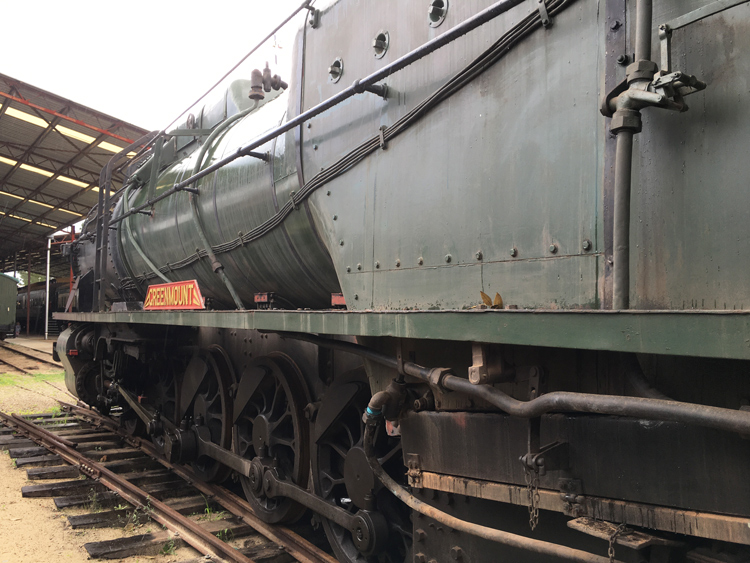
Looking forward, including some details of the lubrication
pipe run, ashpan and injector pipework.
Photo kindly contributed by Rowan Kinnane and dated 27
August 2025.
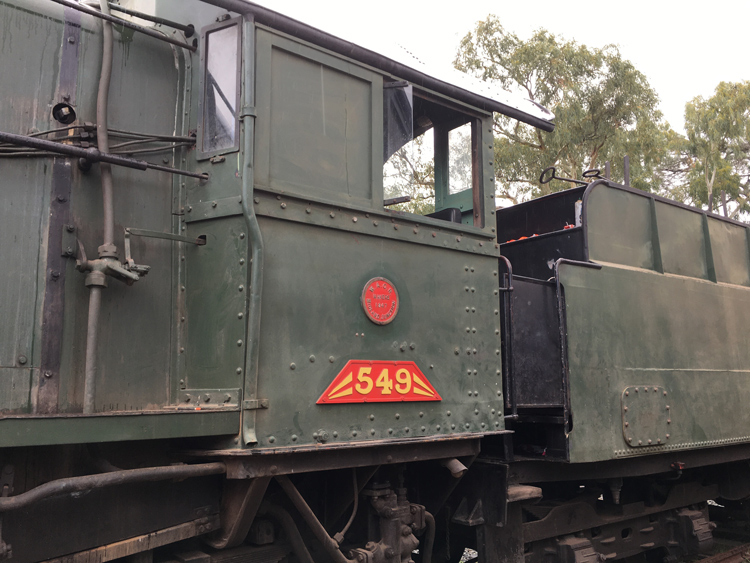
Cabside and tender detail.
Photo kindly contributed by Rowan Kinnane and dated 27
August 2025.
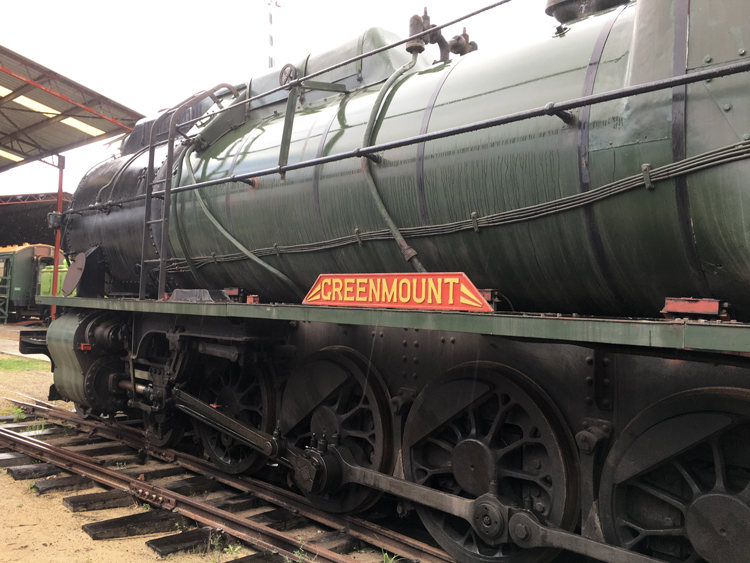
The ‘Greenmount’ nameplate centres this forward view. What
looks like a chimney cover is resting out of place against the front steam
inlet pipe.
Photo kindly contributed by Rowan Kinnane and dated 27
August 2025.
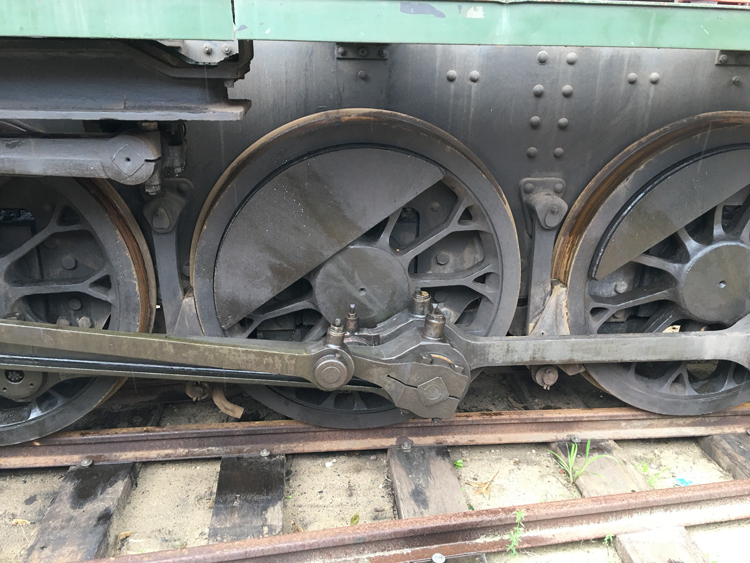
A second view of the wheels & motion including connecting
rods, bifurcated wheel spokes and counterweights.
Most rods are machined plain but the
connecting rod is fluted, perhaps to save weight.
Photo kindly contributed by Rowan Kinnane and dated 27
August 2025.
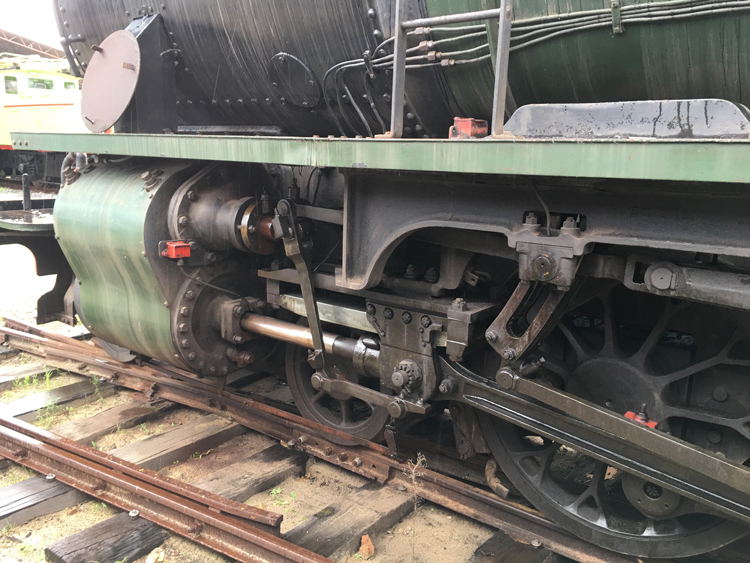
A second view of the cylinders and valve gear. The fluted
connecting rod is clearly seen.
Photo kindly contributed by Rowan Kinnane and dated 27
August 2025.
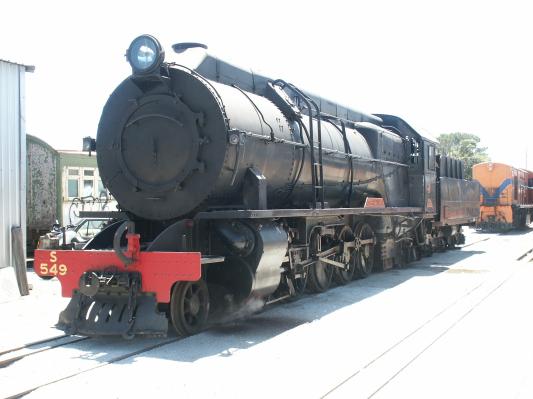
An earlier view showing S 549 in steam on 17 November 2002 during
'Railfest 2002’ at Bassendean.
At that state the cowling had been
reinstated along the full length of the boiler, as originally built in 1947.
This photograph was contributed by Stuart Jackson.
References
|
a |
A. Gunzburg
'A history of WAGR steam locomotives', published
by ARHS (Western Australian Division) 1984. |
|
b |
Gray. W. K., 'Guide to Rail Transport Museum,
Bassendean, Western Australia', Australian Railway Historical Society W. A.
Division, First Edition November 1999. |
|
c |
Rail Heritage WA website, Photo Archive, (via various images as represented on this
page) retrieved 9 July 2026 |
|
|
|
Page updated: 13 July 2026
|
Government Railways: |
|
|||||||||
|
Private & Industrial Railways: |
|