|
|
ASG Water Tanks Remnants of the Australian Standard Garratts |
|
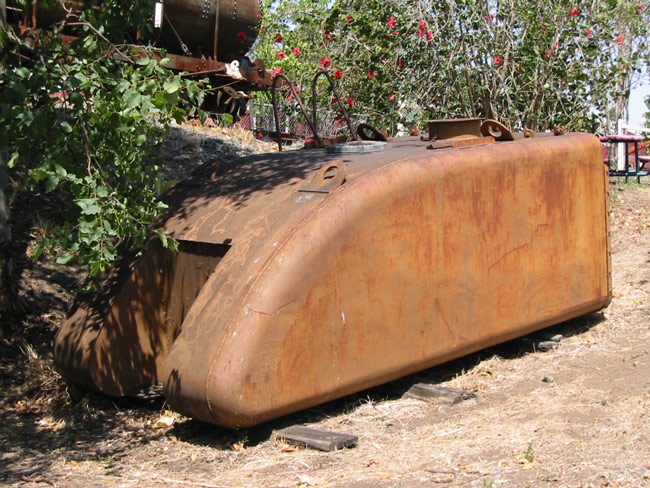
One of the distinctive ASG front water tanks survives at
the Rosewood Railway, as seen in this photo of 8 October 2004.
These tanks were of modern welded construction. Other details
include the prominent front cut-out and lifting lugs on the tank top.
|
The
Australian Standard Garratt (ASG) was proposed and designed by the
Commonwealth Land Transport Board in 1942 in response to the urgent need for
powerful locomotives for the nation’s 3' 6”-gauge railways during World War 2.
The design team was supervised by the Western Australian Government Railways
(WAGR) Chief Mechanical Engineer Mr. F. Mills - and to the webmaster’s eye, the
ASG bears similarity to his contemporary WAGR S-class 4-8-2 locomotives including
the distinctive boiler cowling. Sixty-five ASG locomotives were authorised
for production with the components assembled at several Australian workshops: Newport Workshops (Vic) - 16 Islington Workshops (SA) - 12 Clyde Engineering (NSW) - 27 Midland Workshops (WA) - 10 The first
ASG locomotives were in steam within 12 months of design starting, reflecting
the wartime emergency conditions in which the class was conceived. They were
immediately put into service with initial success, providing significant
additional motive power for the heavy wartime traffic. However, it seems that
aspects of the design were too rushed as flaws became apparent and in time
the ASGs became very unpopular with crews. Indeed, the ASG locomotives were subject
to strike action and a Royal Commission in WA. Construction ceased in
December 1945 with 57 units assembled and most were destined for relatively
short working lives. None of
the ASG locomotives allocated to the Queensland Government Railways have
survived, but several components were adopted for further use and remain in
existence. A few ASG front water tanks survive across Australia, with one
example preserved by the Australian Railway Historical Society (Queensland
Division) at their Rosewood Railway. A second example is stored at The
Workshops railway museum, Ipswich. A third example was discovered at a
Sunshine Coast home, where it had been adapted for use as a domestic
rainwater tank! The only
complete ASG survivor is G 33 which operated at the Fyansford Cement Works in
Victoria and is being restored to operation at the Bellarine Railway at
Queenscliff, Victoria. For more
information about the ASG locomotives, refer to the page for G 33. |
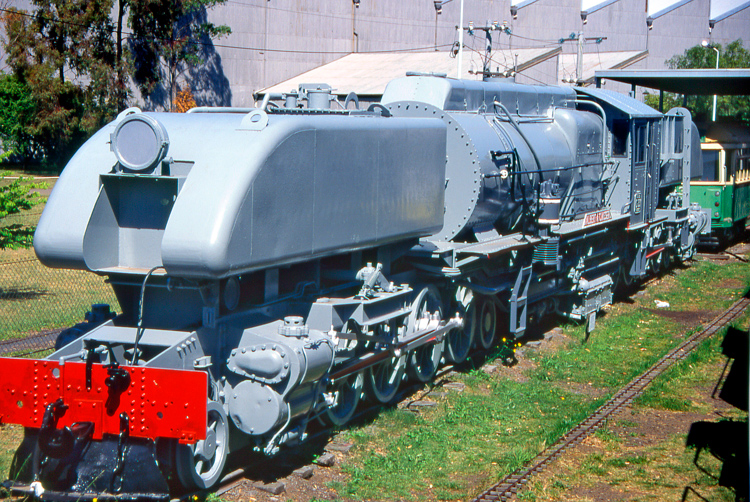
G 33 'Albert A Gunsser' on display at the North
Williamstown railway museum on 4th December 1994.
It appears to have recently been
repainted into the unlined grey livery worn at the Fyansford cement work.
G 33 is now under restoration to operation
at the Bellarine Railway, Queenscliff.
This view was kindly contributed by Tony Bartlett.
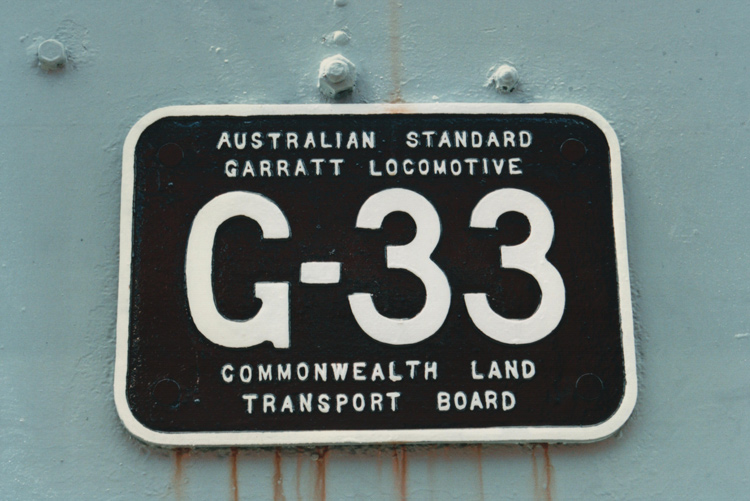
G 33's numberplate shows the Commonwealth Land Transport
Board parentage of the Australian Standard Garratt locomotives.
This scanned photo dates from a period when G 33 was displayed
at North Williamstown in Fyansford grey livery.
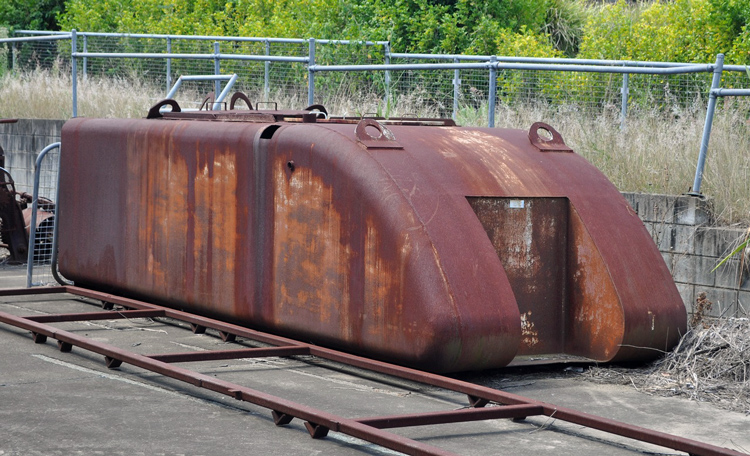
This ASG water tank is stored at the rear of The Workshops
railway museum at Ipswich.
My thanks to David Bromage for contributing this photo of
19 October 2014.
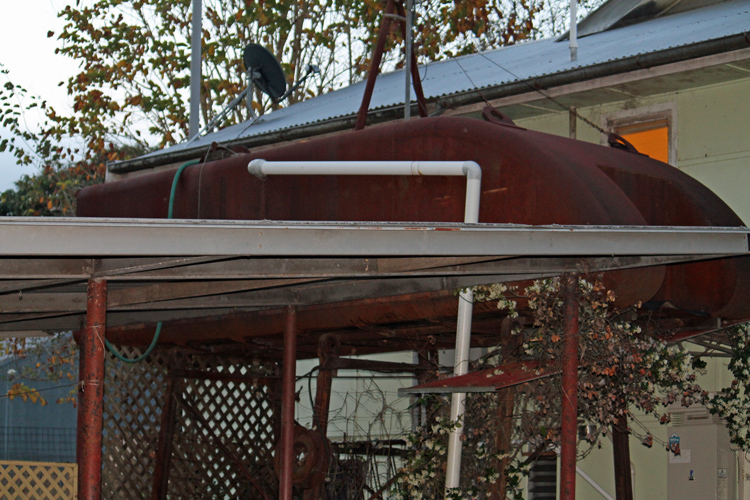
This ASG front water tank was adapted for use collecting
rainwater at a house on the Sunshine Coast, Qld! 30 October 2014
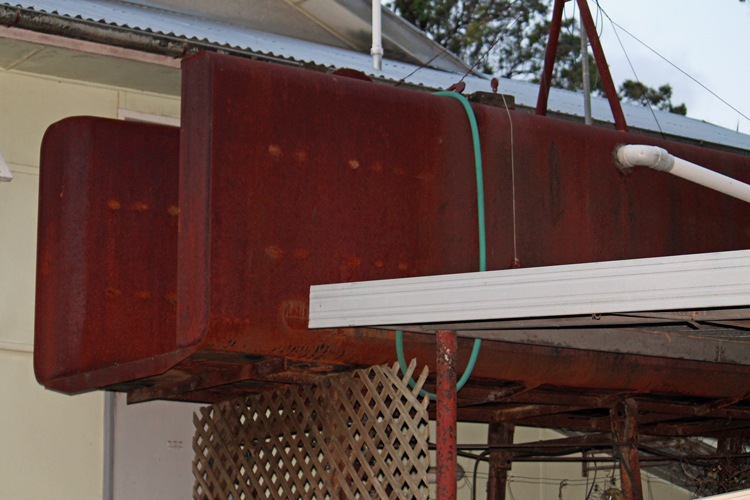
Rear view of the ASG front water tank at a Sunshine Coast
home. 30 October 2014.
References
|
a |
A. Gunzburg
'A history of WAGR steam locomotives', published by
ARHS (Western Australian Division) 1984. |
|
b |
West A. M.,
'Crimson Giants - The Articulated Steam Locomotives of Queensland Rail' published by
the Australian Railway Historical Society, Queensland Division, 1995. |
|
c |
Fluck R.
E., Sampson R., & Bird K. J. 'Steam
locomotives and Railcars of the South Australian Railways', published by
The Mile End Railway Museum (SA) Inc, 1986. |
Page updated: 27 May 2026
|
Government Railways: |
|
|||||||||
|
Private & Industrial Railways: |
|