|
|
D-58 Class Some surviving components |
|
|
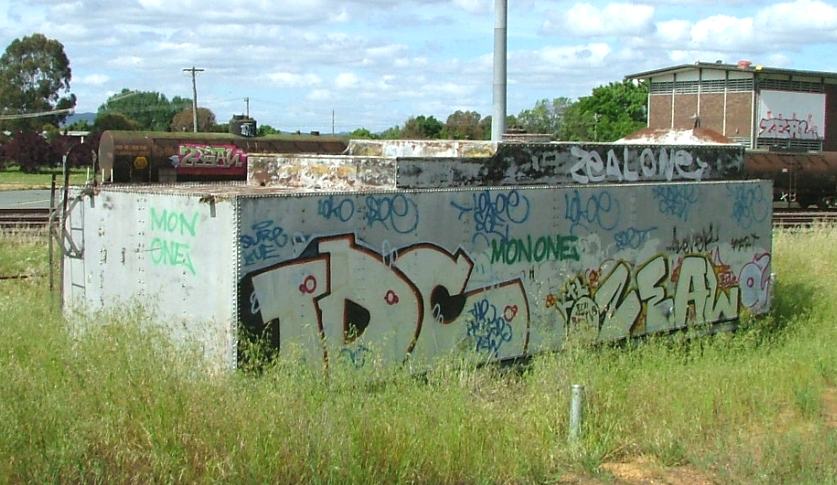
5808's tender tank at Canberra, adapted for use as a
diesel fuel bunker. This photo was kindly contributed by David Bromage and is
dated 6 November 2005. |
|
Builder |
NSWGR Eveleigh Workshops – 11 NSWGR Cardiff Workshops - 2 |
|
Builder’s Number & Year |
1950 - 1952 |
|
Wheel
Arrangement |
4-8-2 |
|
No. in Class |
13 completed (25 originally planned) |
|
The D-58 class
was designed by the NSW Government Railways (NSWGR) as an improved version of
the earlier D-57 class 4-8-2 heavy good locomotives supplied by Clyde
Engineering, retaining the 3-cylinder design but using rack-and-pinion valve
timing instead of the Gresley conjugating valve gear used by the D-57’s. Construction
was split between the Eveleigh Workshops, Sydney and Cardiff Workshops,
Newcastle. These two types were known by railwaymen as the ‘Big Engines’. 25
locomotives were planned, however only 13 were completed following
cancellation of the construction program due to poor performance of the
delivered locomotives and a policy change favouring diesel traction.
Electrification of the Blue Mountains line in 1957, and the ‘Short North’ to
Gosford, severely curtailed the usefulness of the D-57 & D-58 ‘Big
Engines’ and by the early 1960’s they were withdrawn awaiting scrapping, with
many stored tenderless in the forlorn ‘Bank’ scrap sidings at Enfield. Despite
cancellation of the D-58 program, it seems the NSWGR were proud of these locos
at one stage: ·
In 1955, loco 5805 featured in the NSWGR Centenary
Exhibition at Central Station as an example of the latest modern freight
power, displayed alongside other modern and veteran exhibits including No.1, 1243,
1948, 3264 and 3813. ·
A representation of 5801 appears in a major mural in the Central
Station eateries hall, featuring both railway and Aboriginal themes – as shown
in photos below. I’m not familiar with the background to this mural, but I
imagine it was completed in association with the 1955 Centenary Exhibition. ·
To commemorate the railway centenary, published in 1955
was ‘The Railways of New South Wales 1855 – 1955’ to showcase the history and
evolution of the NSWGR since inception. Chapter 11 ‘The magic of Locomotives’
includes a wonderful panning photo of 5801 galloping along, captioned ‘Present
day “D58” Mountain Class goods locomotive used for heavy haulage’. (My primary
school library had a copy of this wonderful old book, which intrigued the
young webmaster with photos of mysterious extinct locos such as the D58’s,
Z11 4-4-2T’s and N67 0-6-0T Terriers.) Photographs
of the NSWGR Chullora Workshops in the 1960’s show many unassembled D-58’s components
lying in storage, including the cast-steel engine frames. I recall one view
showing workers using the frames as a handy seat during a sunny lunch meal break! The 13
completed D-58 class were all were withdrawn after short lives and
regrettably none were preserved. I understand the NSWGR authorities
considered the D57 and D58 class locos as the same – true from an operational
perspective, but not from a ferroequinologists perspective - and hence denied
requests from enthusiasts for one to be set aside for a proposed railway
museum, with 5711 being saved to
represent both types and now the only surviving example of the NSWGR ‘ Big
Engines’. Today only
a few physical D-58 items remain: Tender
tanks Many D-57
and D-58 class tenders were retained as water tankers, permanently coupled
back-to-back in pairs, and survived in this capacity well past the scrapping
of their donor locomotives. One of these tenders is now preserved by the Dorrigo
Steam Railway & Museum. Another example is that from 5808, which survives
at Canberra station after being adapted for use a diesel fuel bunker for the
local shunt engine. Cylinder
& saddle castings Among the
workshop spares at the NSW Rail Transport Museum, Thirlmere were some D-58
components including the huge cylinder & smokebox saddle castings assembled
to make a 3-cylinder front-end. These cylinders appeared to be unused and
presumably came from one of the unassembled D-58 machines. These were stored
within the old northern workshop area prior to the museum site upgrade of
2009 - 2010. I understand this cylinder assembly is now stored off-site,
together with the spare boilers. Hopefully these cylinders could one day be
cleaned-up and placed on display - perhaps on a freight wagon - as an example
of the heavy engineering involved in steam locomotive construction, and an
excellent educational item to show how expanding steam is translated into
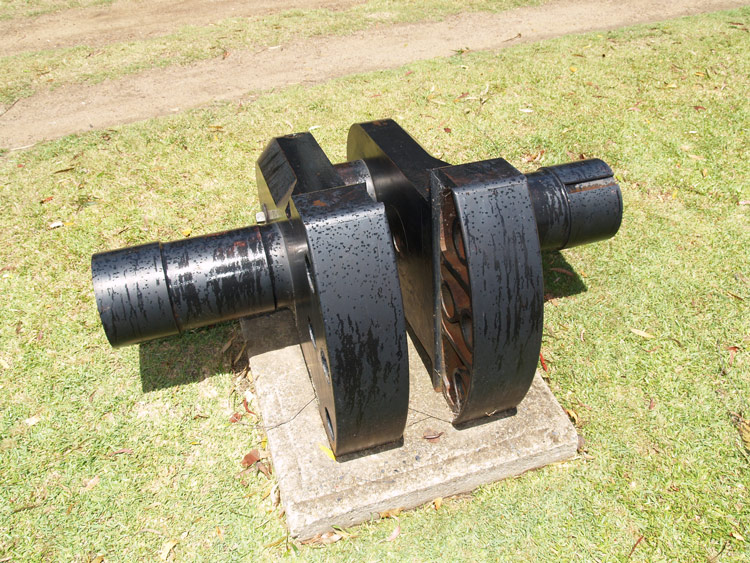
reciprocating motion and tractive effort. Crank
Axle An impressive crank axle is displayed in the Thirlmere
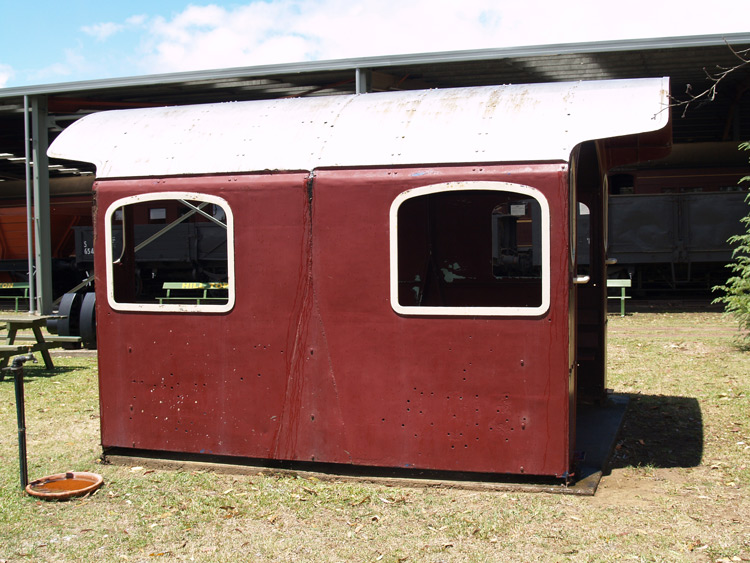
grounds, a relic of either a D-57 or D-58 class loco (photo below). Cabs In the
early years at Thirlmere, two picnic shelters were created by welding together
pairs of old steam locomotive cabs. One of these shelters (photo below) comprised
the cabs from unassembled locos 5814 & 5815. Maybe one could
be transformed into a steam loco cab exhibit, with a reproduction backhead populated
with all the wonderful copper and brasswork that makes up a steam loco’s
control systems. Boilers Some D-58
class boilers found use as stationary steam plant in industry, and I understand
one survives at a sawmill near Deepwater in the New England region of
northern NSW. Perhaps this was one of the unused boilers from the unassembled
locomotives – which would have been “No Mileage, No Rust”! |
|
5814 & 5815 cabs welded back-to-back to form a picnic
shelter. It is apparent from the rust marks that the brass numbers had been
attached for some years. 5814 & 5815 were never completed so
presumably these components were among those lying around at termination of
the D-58 class build project. I believe these cabs remain in storage somewhere at the
NSW Rail Museum, although I haven’t seen them for a decade. |
|
This crank-axle from a 3-cylinder locomotive was on
display at the NSWRTM. It would have been for either a D-57 or D-58 class locomotive. |
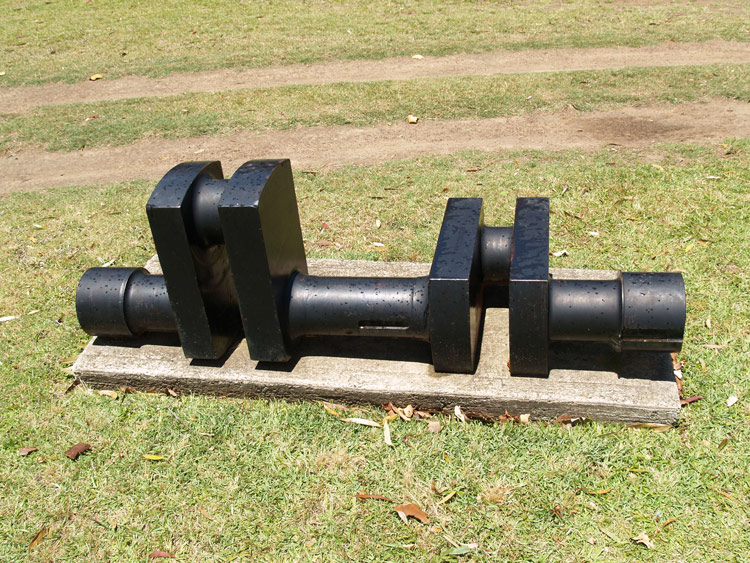
In comparison to the picture above, here is the crank axle
for an inside cylinder (2-cylinder) locomotive.
(I don't know what type of locomotive this came from, but certainly not a D-58 or D-57!)
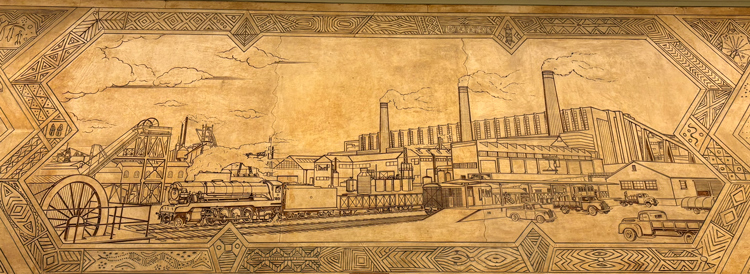
Among the murals in the Central Station eateries hall is
this view, featuring both railway and Aboriginal themes.
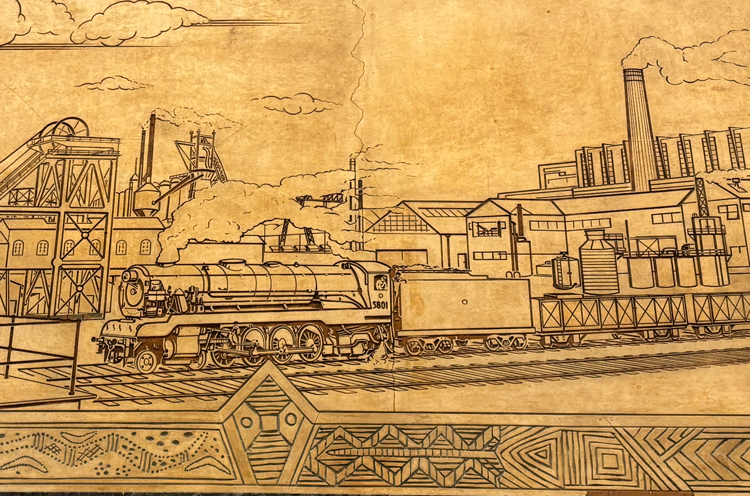
A close-up of the mural: Modern steam power 5801 proudly serving
Industry.
Alas the pride didn’t last long, and the D-58 class were
extinct by the early 1960’s.
References
|
a |
‘Locomotives of Australia’ by Leon Oberg, published by J. W. Books Pty Ltd, 1982 reprint. |
|
b |
‘A Compendium
of New South Wales Steam Locomotives’ compiled
by Alex Grunbach, published
by the Australian Railway Historical Society, New South
Wales Division, 1989. |
|
c |
‘Steam
Locomotive Data’ July 1974 edition, compiled
by J. H. Forsyth for the Public
Transport Commission of NSW. |
|
d |
Wikipedia
page for NSWGR D58 class locomotives: New
South Wales D58 class locomotive Retrieved 10
June 2026 |
|
e |
‘The
Railways of New South Wales 1855 – 1955’ Published
by the Department of Railways, NSW.
1955 |
|
f |
Webmaster’s
observation or comment |
Page updated: 17 June 2026
|
Government Railways: |
|
|||||||||
|
Private & Industrial Railways: |
|