|
|
1301 NSW Rail Museum, Thirlmere |
|
|
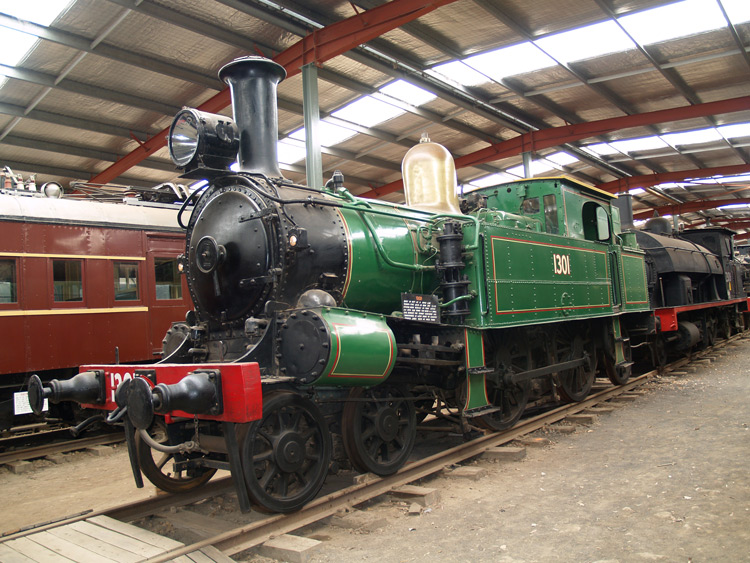
1301 displayed at the NSW Rail Museum, Thirlmere on 23
November 2008. The loco has been beautifully restored for static display
and wears lined green livery, with electricity supply to the headlight and marker
lights. |
|
|
Builder |
Beyer
Peacock & Co, Manchester |
|
Builder’s Number & Year |
1624 of 1877 |
|
Wheel Arrangement |
4-4-2T (originally 4-4-0) |
|
No. in class |
20 |
|
Built by
the famous Manchester, UK builders Beyer Peacock & Co as early as 1877,
this locomotive was originally class leader C 79 of the eponymous C(79) 4-4-0
engines for New South Wales Government Railways (NSWGR), designed for express
passenger and mail train duties. The C(79) class proved successful in traffic
and ultimately grew to 68 machines. The design reflected a classic Beyer Peacock
pattern with inclined cylinders, with the leading 4-wheel Bissell bogie an evolution
from the NSWGR’s earlier 2-4-0 G(23) class locos of 1865. Another well-known example
of this general Beyer Peacock design is Metropolitan Railway 4-4-0T No.23
which is a star exhibit in the London Transport Museum in Covent Garden. In time,
further developments in locomotive design led to the introduction of the more
powerful P(6) class 4-6-0 locomotives in 1892, following which some of the
smaller C(79) class locomotives became surplus. Accordingly, between 1896 and
1902 twenty members were converted to 4-4-2T configuration for further work
in Sydney suburban passenger duties. The first locomotive converted was class
leader C 79, and hence the 4-4-2T locomotives became known as the CC(79)
class (later Z13 class), while the remaining 4-4-0 tender locomotives became
the C(80) class (later Z12 class). The CC(79)
class tank locomotives were again displaced from suburban passenger duties
following the introduction of the more modern S(636) class 4-6-4T locomotives
from 1903. Members of the CC(79) class found further employment on various
branch lines including the Yass Tramway and the Picton-Mittagong Loop Line,
while others served shunting needs. Photos
show 1301 found use on the Yass Tramway And Picton-Mittagong Loop Line. In 1962
its historical significance was recognised when it was selected for ‘Vintage
Train’ duties, hence surviving in traffic longer than most steam locomotives
during the diesel changeover years. It ultimately came into the collection of
the NSW Rail Transport Museum (NSWRTM) at Enfield Roundhouse. 1301 steamed to
the new NSWRTM site at Thirlmere on 19 June 1975 in a triple-header with 2705
and 176 (1243); 1301 being stabled at Picton loco depot before being towed to
Thirlmere on 20 June 1975. To my knowledge this transfer was the last time
1301 was in steam. This
locomotive would have made authentic and historic motive power for NSWRTM (now
NSW Rail Museum) loop line tourist trains, had it ever been restored to traffic,
possibly explaining why three members of the Z13 class (1301, 1307 &
1308) were originally retained by the NSWRTM. I believe a spare Z12 / Z13
class boiler is also held among the NSW Rail Museum spares. Today 1301
is fully restored for static display and wears lined green livery, with
electricity supply to marker lights and other details. It is interesting to reflect
that this loco presumably worked trains over the loop line through Thirlmere many
times over the decades, both on the original 1860’s alignment and improved 1890’s
deviations as a C(79) passenger 4-4-0, and then later in CC(79) / Z13 4-4-2T
configuration on the local passenger and pick-up goods trains. Ron
Preston's wonderful book ‘Tender into Tank’ includes many photographs and
historical details of the Z13 class locomotives and their operations,
including photos of 1301 working on the Yass Tramway in the 1950's. UPDATE: A 2022 visit
to London provided an opportunity to photograph Metropolitan Railway No.23 at
the London Underground Museum, Covent Garden, as seen below. I had been
eagerly anticipating taking many detailed ferroequinological photos of the 4-wheel
Bissel truck, cylinders and driving wheels etc for comparison with the NSWGR Z12
& Z13 classes… but was disappointed to find No.23 poorly presented, with
key details hidden under viewing platforms or behind perspex screens, an interpretive
panel and a video monitor. None-the-less, the photos below illustrate some
family resemblance. The London
Transport Museum Collections Page for Metropolitan Railway No.23 provides excellent
content & context for this historic loco. |
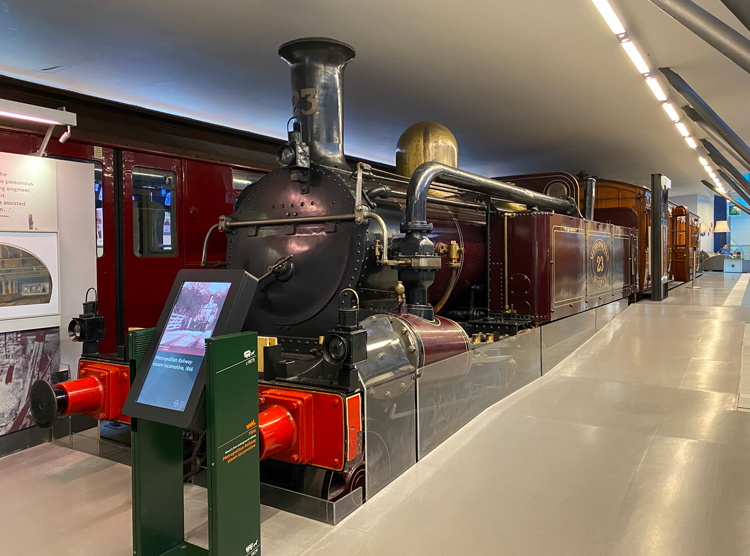
Metropolitan Railway 4-4-0T No.23 on display at the London
Transport Museum, Covent Garden on 22 September 2022.
The fun police have ensured everything is
shielded behind Perspex, and there is no gap between the platform to view the
wheels and motion.
Perfectly situated to block the front ¾ view
of the loco is a video cabinet looping film of Metropolitan Railway suburban operations
–
perhaps a nod to today’s younger generation,
who might prefer to look at a screen even when the real item is right in front
of them, and perhaps
imagine that the driver controlled the
loco through a GUI interface while the fireman monitored fire, water and steam
levels like a computer game.
The broader interpretive displays about the role of railway
companies promoting suburban development on London’s fringes were excellent…
but it was a pity that this iconic exhibit was so poorly positioned and compromised
by inappropriately placed display panels and screens.
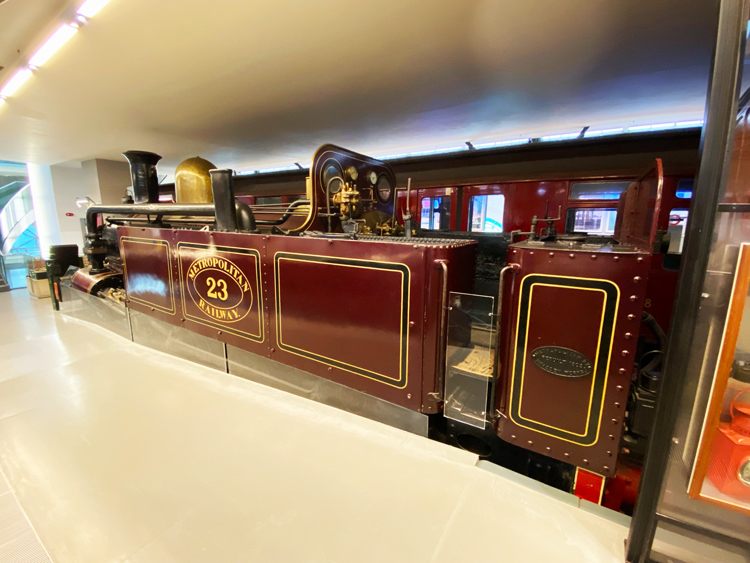
The viewing platform provided reasonable visibility of the footplate,
but younger visitors might imagine Met No.23 was a maglev vehicle since it has
no visible wheels!
The condensing apparatus, vital for Metropolitan
Railway underground running, is evident with the exhaust steam pipe leading
into the side tank and a breather / exhaust alongside.
Enclosed cabs were not common in the 1860’s
and for the Metropolitan Railway, much running was in underground tunnels anyway.
References
|
a |
‘Locomotives
of Australia’ by Leon Oberg, published
by J. W. Books Pty Ltd, 1982 reprint. |
|
b |
‘A
Compendium of New South Wales Steam Locomotives’ compiled by Alex Grunbach, published
by the Australian
Railway Historical Society, New South Wales Division, 1989. |
|
c |
‘Steam
Locomotive Data’ July 1974 edition, compiled by J. H. Forsyth for the Public
Transport Commission of NSW. |
|
d |
‘Roundhouse’
magazine published by the NSWRTM, Volume XIII No.2 of July 1976, article
‘Museum on the Move’ pp.17. |
|
e |
‘Tender
Into Tank’ by R. G. Preston. Revised, enlarged &
republished by New
South Wales Rail Transport Museum, 1984. |
|
f |
Webmaster's observation or comment |
Page updated: 30 March 2026
|
Government Railways: |
|
|||||||||
|
Private & Industrial Railways: |
|
|