|
|
1042 Maitland Steam & Antique Machinery Association |
|
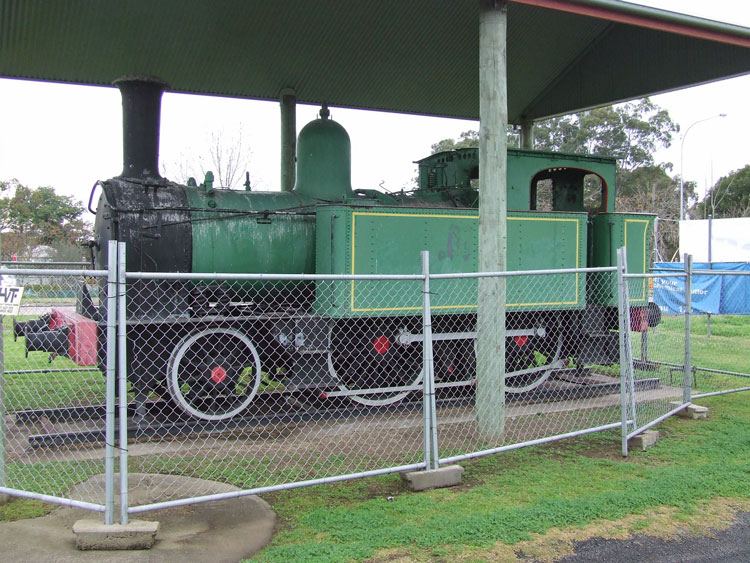
This photo was contributed by my friend Chris Thompson and
shows 1042 plinthed at Maitland on 29 July 2010.
As can be seen, 1042 was now fenced off
from public access and the paint had aged since first 1042 was first plinthed
at Maitland (refer photo below).
Whilst the weather roof no doubt provided
some protection from the elements, alas it also created a handy bird roost
and 1042 now wore a ‘filthy green streaked with bird lime’
livery!
|
Builder |
Henry Vale & Company, Sydney |
|
|
Builder’s Number & Year |
38 of 1887 |
|
|
Wheel Arrangement |
2-4-0T |
|
|
No. in class |
18 |
|
|
This
historic old locomotive was built by Henry Vale & Company at their Sydney
works under an order for six additional 2-4-0T suburban passenger engines of
the F(351) class for the NSW Government Railways (NSWGR). This order followed
the original twelve F(351) class locomotives supplied by Beyer Peacock &
Co, bolstering the class to a total of 18 machines. It was originally
numbered F 365 and received the number 1042 among the ‘X10’ grouping of
miscellaneous and obsolete locomotives & cranes in the NSWGR's 1924
renumbering scheme. The F(351)
class 2-4-0T locomotives followed the design of earlier machines supplied by
Beyer Peacock & Co from 1864 to private railway companies on the Isle of
Wight. The South Australian Railways P-class locomotives (represented by P 117 at the National Railway Museum,
Port Adelaide) were also members of this Beyer Peacock & Co design
family. The F(351)
class were removed from Sydney suburban passenger workings following a fatal
accident at Sydenham in 1901, following which they were relegated to workshop
and depot shunting duties. Ten were sold into industrial service, including F
360 which worked on the Wolgan Valley Railway to Newnes, but none of those
sold to industry survived into preservation. Sister locomotive 1033, from the initial Beyer Peacock
& Company order, finished its career at Eveleigh Locomotive Workshops and
is now a static exhibit at the NSW Rail Museum, Thirlmere. No.1036 is
remembered as the long-time depot shunter at Junee Roundhouse, where it was
affectionately known as ‘Fanny’. Alas it didn’t survive but its boiler is
carried by preserved 1076. Alex
Grunbach's authoritative book ‘A Compendium of New South Wales Steam
Locomotives’ provides a good history of the F(351) class and disposal details
for those sold into industrial service. Also included is information about
the Sydenham crash of 1901 and subsequent investigation, which struck the
webmaster as interesting reading with some modern parallels! 1042 ended
its NSWGR working career in January 1973 as the Cardiff Workshops shunter,
Newcastle and was later plinthed outside the works. Following the later
closure of the Cardiff Workshops by the State Rail Authority, 1042 was moved
in 1994 to Maitland, repainted and plinthed. The Maitland Visitors Centre was
later built at this location and 1042 was repositioned alongside the visitors
centre, with a weather roof provided. Unfortunately, the locomotive
deteriorated during its years plinthed at Maitland. During
2010 there was a proposal to restore this locomotive to operation in
connection with the Hunter Valley SteamFest, including a main-line connected
locomotive shed and display centre adjacent to Maitland station. Photos from
late 2011 suggest this project was proceeding with 1042 under restoration at
a newly constructed workshop facility somewhat to the west of Maitland
station, near the former South Maitland Railways junction and exchange
sidings. Isle of
Wight Central Railway: As
previously mentioned, the F(351) class design followed a family of earlier
Beyer Peacock & Co 2-4-0T locomotives supplied to private railways on the
Isle of Wight from 1864. ‘Ryde’, one of the first three delivered in 1864,
was the oldest engine on the Southern Railway (the amalgam of many railway
companies in the south of England) when sent to Eastleigh workshops in 1932
for proposed preservation, but alas that loco succumbed to the World War 2
scrap metal drives. (A similar fate befell approximately 265 World War 1
tanks which had been placed at various villages around Great Britian as
memorials, all hastily dispatched to the furnace when hostilities
recommenced. As a side story, here is one in Ashford, UK which escaped that fate.) Today a
portion of the Isle of Wight Central Railway survives as a tourist line, the Isle of Wight Steam
Railway. Given the many new-build steam locomotive projects in the UK (my
favourite being the 82045 Steam Locomotive Trust’s project to construct a new
British Railways standard 3MT 2-6-2T), perhaps a replacement Isle of Wight
2-4-0T would make a worthy project - and an appropriate match for the
wonderful collection of antique Victorian 4-wheel passenger cars on the Isle
of Wight Steam Railway. (I understand the required Beyer Peacock & Co
designs & technical drawings are still available in archives.) Here is a
link to a wonderful collection of images of historic the Isle of Wight
Railways steam locomotives: ISLE OF WIGHT RAILWAYS - transportsofdelight 1042
Update – April 2026: The
webmaster visited the Hunter Valley SteamFest on a sunny Sunday 19 April to take
in the various attractions. In addition to the railway activity there was a
huge vintage car display, and a large vintage machinery rally at the Maitland Steam &
Antique Machinery Association showground near Maitland station. Here I
found 1042 placed on a short section of track alongside the main running /
restoration workshop, with tanks, cab, dome cover and various other fittings
stored around the site. The boiler has been repaired to operable condition,
being placed back in the frames during April 2024. I understand the
current plan is a ‘static’ restoration with the loco displayed on its short
line alongside the shed, possibly in light steam and able to provide live
steam to various static machines in a display shed nearby. A selection of
photos below gives a taste of the action at the Hunter Valley SteamFest on Sunday
19 April. |
|||
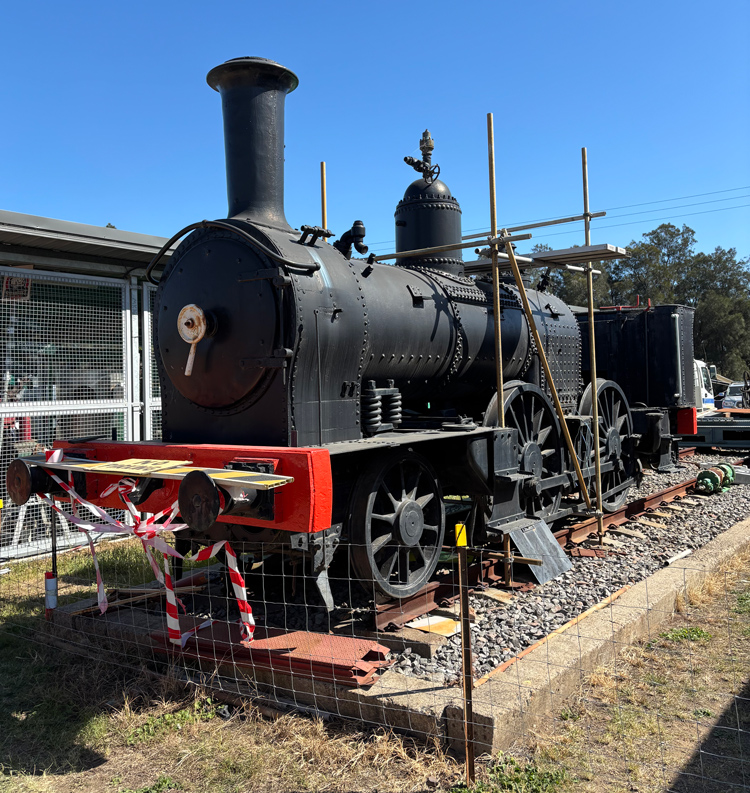
Front view of 1042 alongside the Maitland Steam &
Antique Machinery Association’s running / repair shed. 19 April 2026.
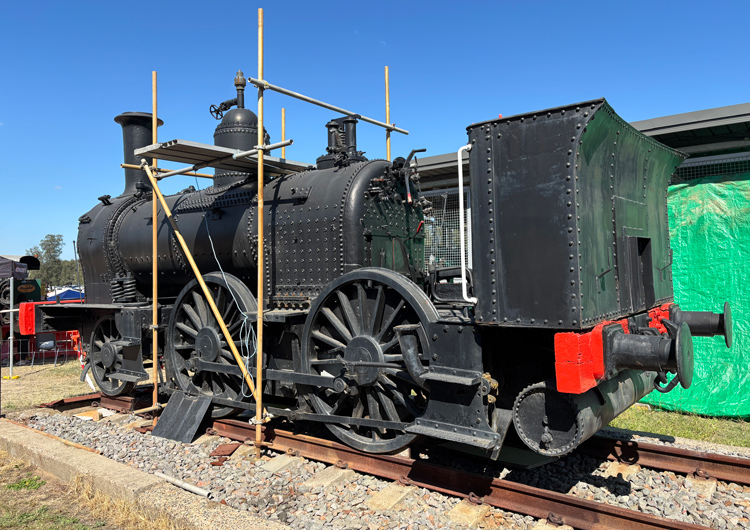
Rear view of 1042 alongside the Maitland Steam &
Antique Machinery Association’s running / repair shed. 19 April 2026.
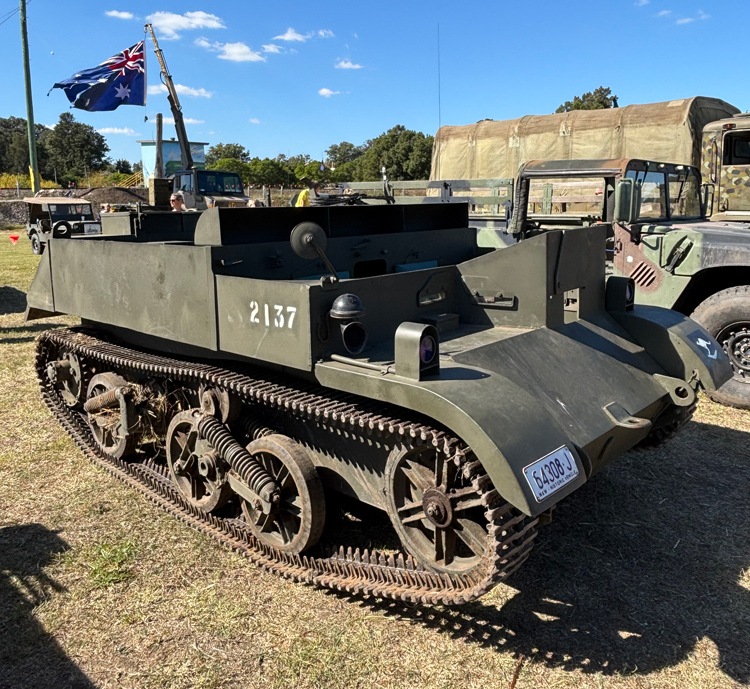
This Australian-built WW2 Gun Motor Carriage (AKA Bren Gun
Carrier) was among the many interesting exhibits on display.
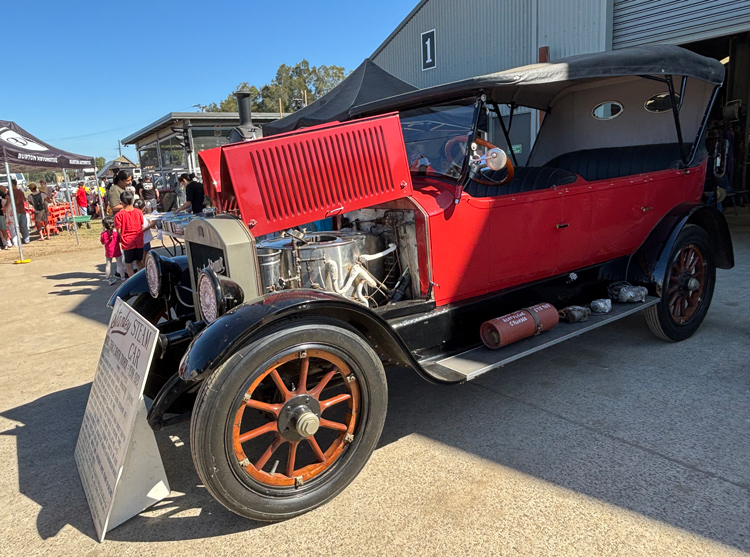
A magnificent Stanley Steam Car had a prime position
outside the main workshop / running shed.
(1042 can just be seen behind the bonnet)
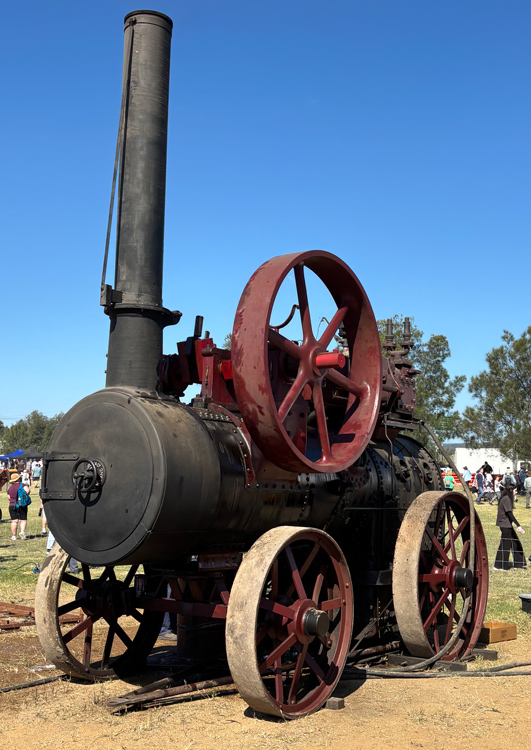
There were many portable steam engines / traction engines
chugging away, but this monster was the largest I have ever seen.
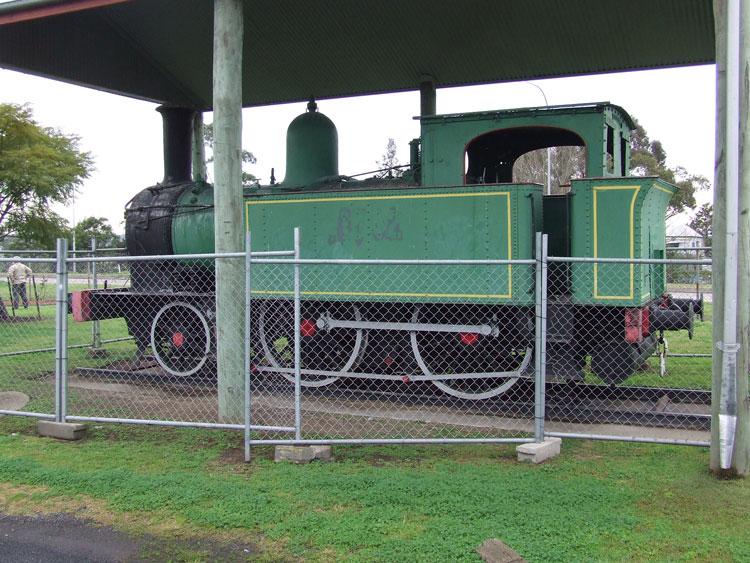
A second view of 1042 dating back to 29 July 2010 and
provided by Chris Thompson.
1042 retains wooden buffer beams at front and rear; a split
can be seen opening in the rear buffer beam.
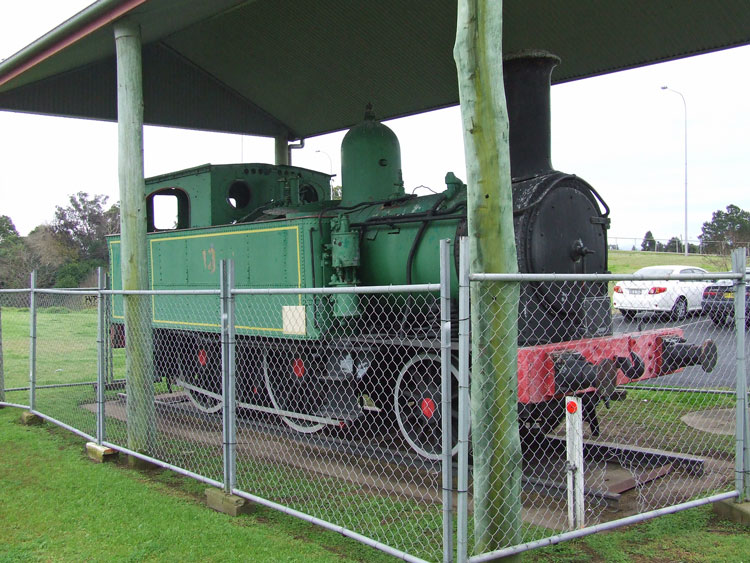
Another view kindly provided by Chris Thompson & dated
29 July 2010.
The position of the weather roof supports and temporary
fence did not make for easy photography!
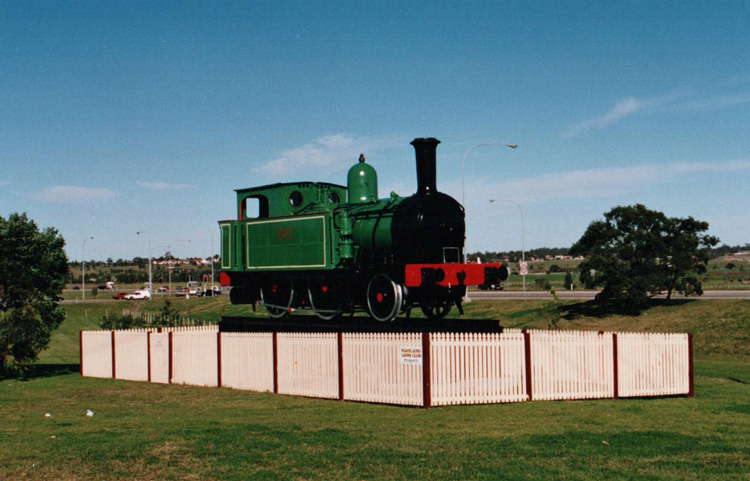
1042 seen at Maitland in 1994 shortly after relocation from
Cardiff Workshops, as initially repainted and placed on a raised plinth behind
a picket fence.
1042 was later moved to a nearby position
alongside the newly constructed visitors centre, and a weather roof added.
The numbers on the side tanks are painted
in gold rather than the original cast brass digits.
I recall being dismayed by the poor
decision to plinth this historic and complete Victorian-era survivor, rather
than placing it in a suitable museum.
Sure enough, it quicky became degraded and decayed, losing
some of its historical value and requiring intervention.
References
|
a |
‘A
Compendium of New South Wales Steam Locomotives’ compiled by Alex Grunbach,
published by the Australian Railway Historical
Society, New South Wales Division, 1989. pp.85 |
|
b |
‘Steam
Locomotive Data’ July 1974 edition, compiled by J. H. Forsyth for
the Public Transport Commission of NSW. |
|
c |
Webmaster's observation or comment |
Page updated: 13 May 2026
|
Government Railways: |
|
|||||||||
|
Private & Industrial Railways: |
|
|